

Sustainability · 2025
In this section51 topics
- Sustainability Policy2 items
- Sustainability Goals & UN SDGs3 items
- Policy Review3 items
- Business Value Chain1 item
- Stakeholder Analysis2 items
- Environmental Policy & Guidelines3 items
- Environmental Policy Review1 item
- Energy — Plan & Guidelines2 items
- Energy — Electricity Consumption1 item
- Energy — Fuel Consumption1 item
- Energy — Targets2 items
- Energy — Performance & Outcomes2 items
- Water — Plan & Guidelines2 items
- Water — Withdrawal, Discharge & Consumption1 item
- Water — Targets2 items
- Water — Performance & Outcomes2 items
- Waste — Plan & Guidelines2 items
- Waste — Generation, Disposal & Recycling1 item
- Waste — Targets1 item
- Waste — Performance & Outcomes2 items
- GHG — Plan & Guidelines2 items
- GHG — Emissions1 item
- GHG — Emissions Verification3 items
- GHG — Principles & Standards1 item
- GHG — Targets1 item
- GHG Targets — Other Targets1 item
- GHG — Performance & Outcomes2 items
- Environmental Legal Incidents1 item
- Other Environmental Management1 item
- Social Policy & Guidelines3 items
- Social Policy Review3 items
- Social — Principles & Standards Practised1 item
- Human Rights Due Diligence1 item
- Employees — Plan & Guidelines4 items
- Employees — Workforce2 items
- Employees — Remuneration & Provident Fund1 item
- Employees — Training & Development1 item
- Employees — Occupational Health & Safety1 item
- Employees — Labour Relations1 item
- Employees — Employee Representation2 items
- Employees — Targets2 items
- Employees — Performance & Outcomes2 items
- Customers — Plan & Guidelines4 items
- Customers — Satisfaction Results1 item
- Customers — Targets2 items
- Customers — Performance & Outcomes2 items
- Community & Social — Plan & Guidelines3 items
- Community & Social — Targets2 items
- Community & Social — Performance & Outcomes2 items
- Other Social Management1 item
- Law Violation Incidents2 items
Sustainability Policy
Has a Sustainability Policy
Yes
Policy Description
The company has established policies and business practices under the framework of three areas of sustainability:
• Environment For operations that promote environmental protection and reduce global impact.
• Social Support job creation, promote the quality of life in communities related to business operations, and ensure the safety of employees and all stakeholder groups.
• Governance To operate transparently and adhere to good governance principles, be accountable to all stakeholders, and drive the organization towards sustainable growth.
Sustainability Goals & UN SDGs
Has Sustainability Goals
Yes
Goals Description
Asian Marine Services Public Company Limited is committed to being a world-class shipyard, utilizing technology to develop production processes to achieve the highest quality, delivery time, and customer satisfaction. We are also driven by innovation that supports long-term sustainability by adopting technologies that reduce greenhouse gas emissions and environmental impact, while also prioritizing social responsibility and adhering to good corporate governance standards.
At the same time, the company has set 10 sustainability goals to align with the United Nations' Sustainable Development Goals (SDGs), as well as committed to operating in accordance with the ISO 14001: 2015 Environmental Management System, the Corporate Governance Code for Listed Companies (CG Code), including providing channels for receiving feedback, suggestions, and complaints from all stakeholder groups. The company also prioritizes the issues received to develop policies and conduct business to achieve sustainable goals.
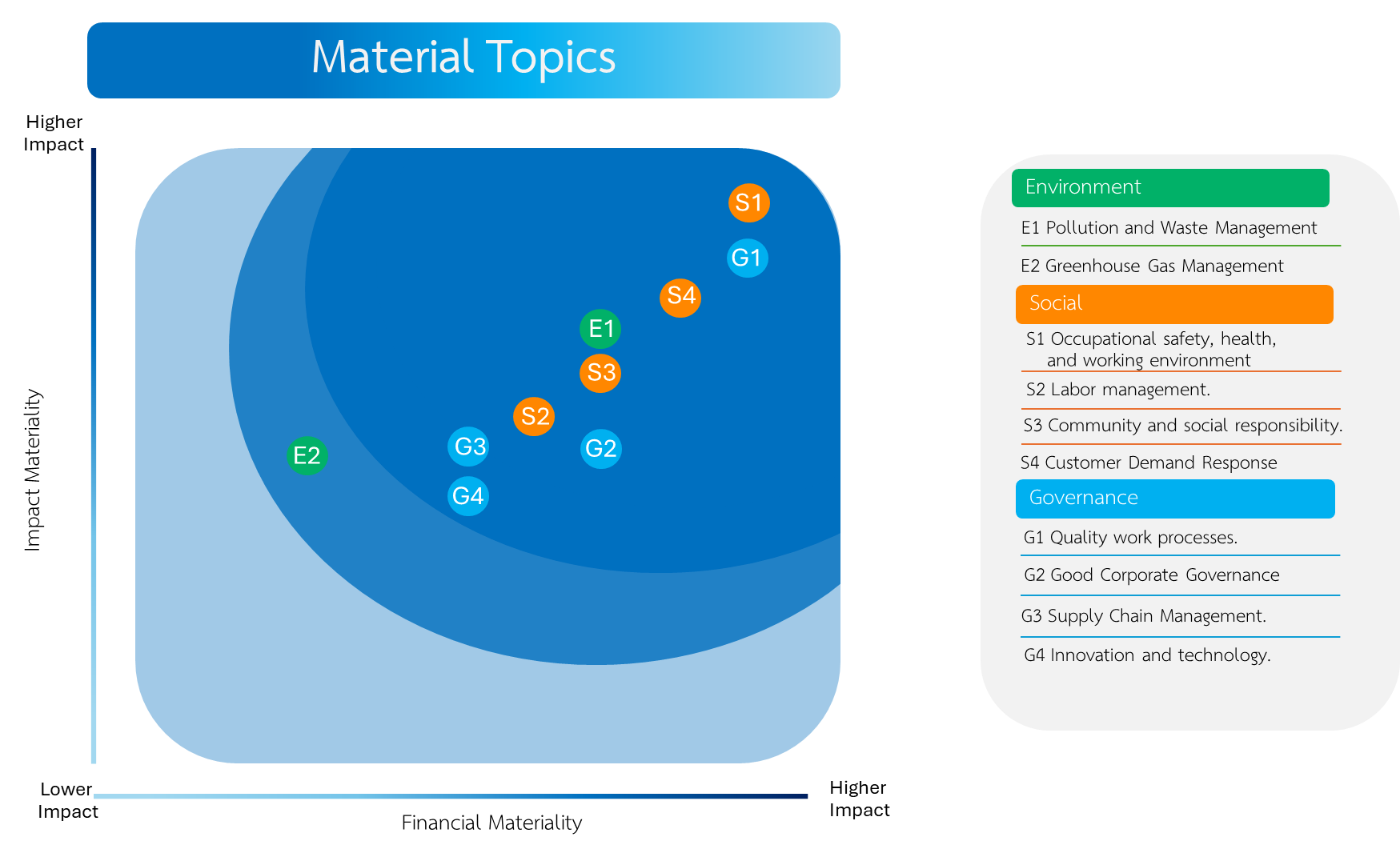
Set sustainability goals that cover 10 material topics as follows:
Pollution and Waste Management
• Environmental complaints are zero.
Greenhouse Gas Management
• Reduce greenhouse gas emissions in Scope 1 and 2 by 1% compared to the 2024 baseline by 2027.
Occupational Safety, Health, and Working Environment
• The number of accidents resulting in more than 3 days of lost work must be zero.
• The number of abnormal health check-ups due to risk factors must not increase from the previous year.
Labor Management
• The organizational engagement score will increase by 0.50 points from 2024 by 2025.
Community and Social Responsibility
• Implement 1 project and participate in 1 community activity by 2025.
Quality Work Processes
• The number of customer complaints regarding quality must be zero.
Customer Demand Response
• The annual average customer satisfaction survey score will be 92% by 2025.
• Identify the real issues raised by recurring complaints from key customers and provide clear responses to those complaints by 2025
Good Corporate Governance
• The corporate governance assessment score will improve from 2024 to 2025.
Supply Chain Management
• 100% of new partners will pass sustainability screening criteria by 2025.
• 50% of key partners will undergo training and sign a business ethics agreement with the company by 2025.
Innovation and Technology
• 10 innovation projects with approved plans will be implemented by 2025.
The full sustainability report can be accessed at https://www.asimar.com/
UN Sustainable Development Goals
| SDG Goal |
|---|
| Goal 3 Good Health and Well-being |
| Goal 3 Good Health and Well-being |
| Goal 5 Gender Equality |
| Goal 5 Gender Equality |
| Goal 8 Decent Work and Economic Growth |
| Goal 8 Decent Work and Economic Growth |
| Goal 9 Industry, Innovation and Infrastructure |
| Goal 9 Industry, Innovation and Infrastructure |
| Goal 11 Sustainable Cities and Communities |
| Goal 11 Sustainable Cities and Communities |
| Goal 12 Responsible Consumption and Production |
| Goal 12 Responsible Consumption and Production |
| Goal 13 Climate Action |
| Goal 13 Climate Action |
Policy Review
Policy Reviewed This Year
Yes
Policy Changed This Year
No
Review Details
The Company regularly reviews its sustainability management policies and targets on an annual basis to ensure alignment with significant changes in various factors, such as business growth, emerging sustainability trends, and relevant laws and standards.
Business Value Chain
Value Chain Description
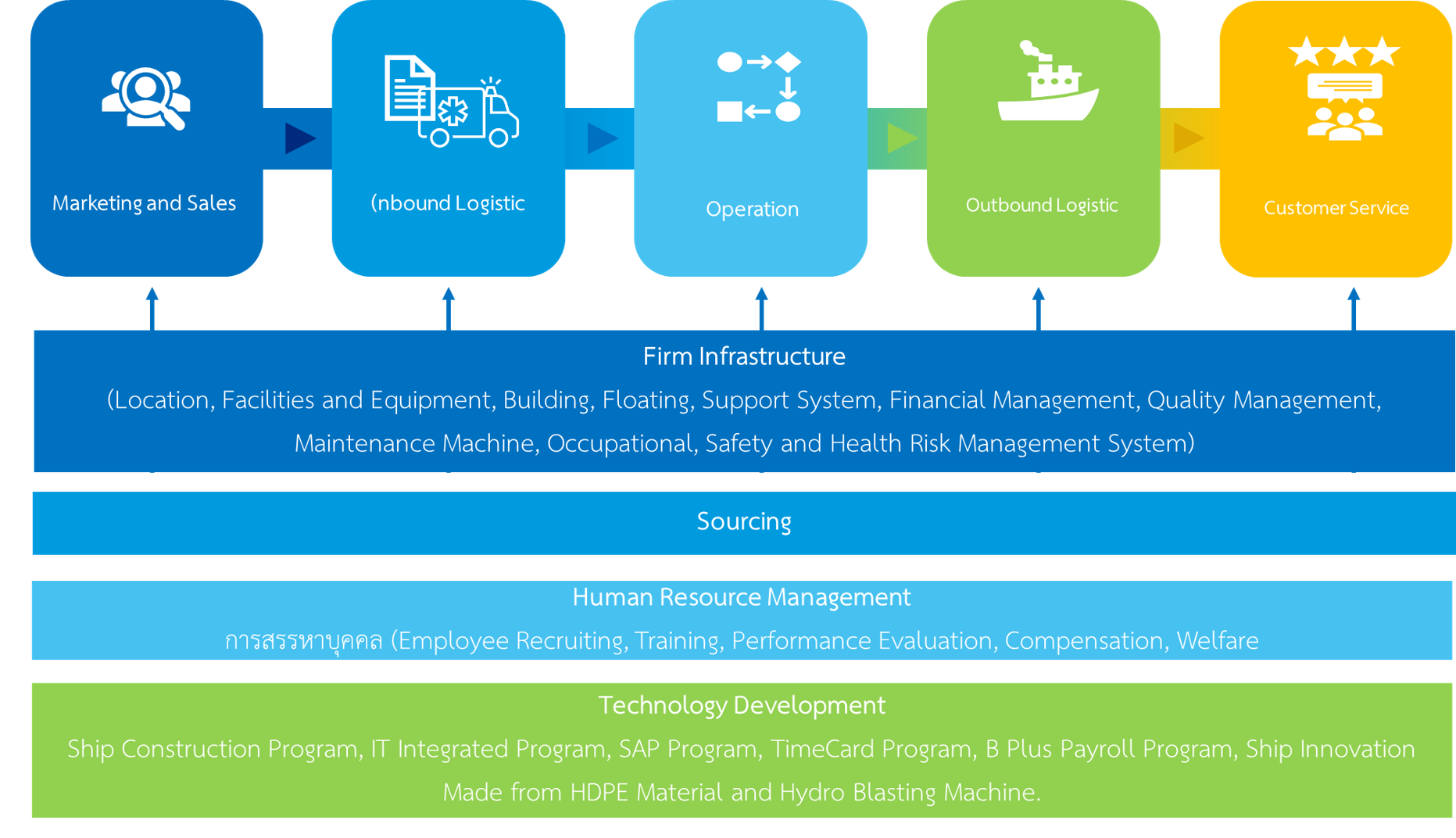
The company places importance on the overall processes related to the organization's business activities throughout the entire value chain, from upstream to downstream. By focusing on enhancing the business and organizational competitiveness through effectively linking various activities to deliver added value to products and services offered to stakeholders, the company has analyzed the value chain as shown in Figure 1. This analysis enables the identification of Material Topics throughout the business operations, from upstream to downstream, leading to the formulation of policies and 10 Material Topics
The activities throughout the supply chain are as follows:
Primary Activities
1.Marketing and Sales
This activity is directly related to responding to customer expectations and demands, starting with identifying customer requirements, tracking the maintenance cycles of each customer's vessel, and using this data for management. It includes planning ship construction or repair, offering pricing and services, as well as contract management. Additionally, it focuses on building and maintaining relationships to ensure that what the organization delivers to the customer is done efficiently, effectively, and on time, providing value.
2. Inbound Logistics
This includes activities related to engineering, ship design that meets customer needs, supplier selection, receiving materials, equipment, parts, and consumables. These activities are closely linked to work planning and warehouse management, which directly impact operations.
3. Operations
This is the core activity of shipbuilding and repair, which involves transforming raw materials into products, also known as production. It includes activities such as manpower planning, budget control, and product quality testing.
4. Outbound Logistics
Once the transformation of raw materials into products is complete, in this case, the shipbuilding and repair, the next step is delivering the products to the customer. This includes activities like collecting, storing, scheduling deliveries, and delivering to the specified locations in the contract.
5. Customer Service
After-sales service, while differing based on each customer’s agreement, is crucial for maintaining ongoing relationships between the organization and customers. Effective after-sales service helps the organization identify the root causes of customer issues and resolve them quickly and accurately, leading to trust, brand loyalty, and repeat orders.
Support Activities
1. Firm Infrastructure
In addition to location, facilities, equipment, buildings, floating docks, and support systems, such as financial/accounting management, quality management, machine maintenance to ensure operational readiness, and occupational safety and health risk management systems, all contribute to the business value chain.
2. Sourcing
This includes activities related to sourcing resources for operations, both in terms of purchasing raw materials for production and sourcing labor, as well as negotiating with partners and building good relationships with suppliers.
3. Human Resource Management
This support function is crucial to the organization's competitive ability. Human resource management involves recruitment of qualified employees, training, performance evaluation, compensation, and the provision of fair and comprehensive employee welfare.
4. Technology Development
This focuses on studying new innovations and promoting employees to study and experiment with new technologies to develop the organization's competitive ability, both directly and indirectly.
• Direct: For example, introducing new products developed in-house or applying external technologies to provide service alternatives to customers, such as using Hydro Blast to prepare ship surfaces before painting to reduce dust and environmental pollution.
• Indirect: Using ready-made software packages or in-house developed programs, including software for design, planning, accounting, and information technology management, to reduce production time, lower costs, and improve operational efficiency.
Stakeholder Analysis
Introduction
The company has considered the impact assessment on all stakeholder groups, covering both positive and negative impacts from the company's business operations. This assessment identifies eight significant stakeholder groups throughout the value chain: employees, communities, contractors, customers, regulatory agencies, financial institutions, shareholders, and business partners and alliances. The company has established communication channels and engagement formats that cater to the expectations of all eight stakeholder groups, as follows:
Stakeholder Analysis
| Stakeholder Type | Stakeholders | Stakeholder Expectations | Response to Expectations | Communication Activities |
|---|---|---|---|---|
| Internal stakeholders | 2921 · Description: Employees | 1. Stable and progressive career path
2. Fair compensation/welfare
3. Work-life balance
4. Respect for human rights
5. Safety of life and property
6. Good physical health, free from work-related illnesses | 1. Fair performance evaluation
2. Support for employee skill development in various areas
3. Annual salary/benefits adjustments
4. Consideration of additional holidays on Saturdays
5. Equal treatment of employees
6. Good working environment with established safety standards
7. Annual health check-ups and follow-up examinations | 2941 · Description: Online Communication · 2942 · Description: Internal Meeting · 2945 · Description: Complaint Reception · 2946 · Description: Employee Engagement Survey · 2949 · Other name: Company's bulletin board · Description: Others · 2949 · Other name: Communication through Morning Talk activities · Description: Others · 2949 · Other name: Communication relations committee (CSO) · Description: Others · 2949 · Other name: Safety Committee · Description: Others · 2949 · Other name: Suggestion box · Description: Others · 2949 · Other name: Discussion with supervisor · Description: Others |
| External stakeholders | 2923 · Description: Customers | 1. Products/Services that meet the needs
2. Safety of life and property while receiving services at the company's premises
3. Appropriate care
4. Protection of customer information and privacy | 1. Delivery of quality products/services in a timely manner
2. Compliance with safety and occupational health regulations/standards
3. Measures for customer information management | 2941 · Description: Online Communication · 2945 · Description: Complaint Reception · 2947 · Description: Satisfaction Survey · 2949 · Other name: Organization of public relations events · Description: Others |
| External stakeholders | 2902 · Description: Community | 1. Safety of life and property
2. Economic, social, and environmental development
3. Reducing the impact of the organization's operations | 1. Environmental and Safety Management
2. Promotion of and Participation in Community Activities
3. Community Engagement: Building Relationships, Listening to Community Issues, and Finding Solutions Together | 2938 · Description: Visit · 2940 · Description: Social Event · 2941 · Description: Online Communication · 2943 · Description: External Meeting · 2945 · Description: Complaint Reception |
| External stakeholders | 2918 · Description: Contractors | 1. Continuous employment
2. Fair compensation
3. Timely and reliable payment
4. Transparent recruitment process
5. Occupational health and safety standards | 1. Develop skills/exchange knowledge in collaboration
2. Have a transparent and auditable management system
3. Compliance with safety and occupational health requirements/standards | 2941 · Description: Online Communication · 2945 · Description: Complaint Reception · 2947 · Description: Satisfaction Survey |
| External stakeholders | 2899 · Description: Suppliers | 1. Long-term business partnerships
2. Punctual and reliable payments
3. Transparent partner selection process
4. Fair and equal treatment | 1. Fair agreement/contract practices
2. Transparent and auditable selection process | 2941 · Description: Online Communication · 2942 · Description: Internal Meeting · 2945 · Description: Complaint Reception · 2947 · Description: Satisfaction Survey |
| External stakeholders | 2925 · Description: Financial institution | 1. Strong debt repayment ability
2. Good corporate governance
3. Good and consistent profitability and growth
4. Accurate, transparent, and reliable information disclosure | 1. Make full and timely payments.
2. Strictly adhere to financial contracts/terms.
3. Cooperate in providing accurate, timely, and reliable information.
4. Adhere to business ethics. | 2938 · Description: Visit · 2941 · Description: Online Communication · 2945 · Description: Complaint Reception · 2949 · Other name: Disclosure of business reports through various channels, such as the company's website or in document format. · Description: Others |
| Internal stakeholders | 2913 · Description: Shareholders | 1. Ability to pay dividends
2. Good corporate governance
3. Strong financial performance and sustainable growth
4. Accurate, transparent, and reliable information disclosure
5. Positive corporate image | 1. Pay dividends at a fair rate.
2. Have various measures to promote transparency and efficiency in business operations.
3. Have business strategies to increase profitability.
4. Adhere to business ethics. | 2941 · Description: Online Communication · 2944 · Description: Annual General Meeting (AGM) · 2945 · Description: Complaint Reception · 2949 · Other name: Disclosure of business reports through various channels, whether it be the company's website or in document format. · Description: Others · 2949 · Other name: Interviews on various occasions. · Description: Others |
| External stakeholders | 2931 · Description: Government agencies and Regulators | 1. Compliance with relevant regulations
2. Providing accurate, transparent, and reliable information
3. Consideration for the environment, community, and society
4. Positive corporate image | 1. Strictly comply with relevant rules, regulations, requirements, and laws.
2. Conduct business with caution, minimizing impacts on the environment, society, and communities.
3. Provide accurate and reliable information to requesting agencies. | 2941 · Description: Online Communication · 2943 · Description: External Meeting · 2945 · Description: Complaint Reception |
Environmental Policy & Guidelines
Has an Environmental Policy
Yes
Policy Description
The company has an environmental management policy that covers efficient and effective waste management, air pollution, water management, energy management, and prevention of contamination or leakage from the production process under the ISO 14001:2015 international environmental management standard. This includes measurement, management, planning, and corporate carbon footprint reporting under the ISO 14064-1 international standard. The environmental management policy defines guidelines that consider environmental impacts, aligning with the vision and mission for sustainable development, as well as being part of the infrastructure development that serves all stakeholders.
The company is committed to protecting and mitigating environmental impacts by managing air, water, waste, and other materials both within the workplace and surrounding communities. This is done in accordance with environmental policies and relevant environmental laws to ensure safety and address environmental concerns. The company has opened communication channels and complaint channels both during and outside of working hours (24 hours a day), which is part of the measures to monitor potential impacts on the community.
The company has organized training sessions and clarified environmental policies and practices for all new employees on their orientation day, along with obtaining their acknowledgment. This ensures that all employees (100%) are aware of environmental concerns and work together to conserve energy and natural resources, and to increase energy efficiency.
Environmental Guidelines
| Guideline |
|---|
| Electricity Management |
| Fuel Management |
| Water Management |
| Waste Management |
| Greenhouse Gas and Climate Change Management |
| Air Quality Management |
Environmental Policy Review
Policy Reviewed This Year
No
Energy — Plan & Guidelines
Has an Energy Management Plan
Yes
Plan Description
The company has an energy management approach by developing an appropriate energy management system. In addition, the company sets targets and prepares an annual energy conservation plan to be used as a guideline for reducing electricity consumption. The company is committed to reducing and controlling the use of electricity, as well as developing work processes and procuring clean energy to replace electricity.
Energy — Electricity Consumption
Electricity Consumption
| Metric | Current Year | Previous Year | Two Years Ago |
|---|---|---|---|
| Total electricity consumption within the organization (Kilowatt-Hours) | 4,594,000 | 4,432,000 | 4,580,100 |
| Electricity purchased for consumption from non-renewable energy sources (Kilowatt-Hours) | |||
| Electricity purchased or generated for consumption from renewable energy sources (Kilowatt-Hours) |
Energy — Fuel Consumption
Fuel Consumption
| Metric | Current Year | Previous Year |
|---|---|---|
| Crude oil (Barrels) | ||
| Coal (Metric tonnes) | ||
| Jet fuel (Litres) | ||
| Diesel (Litres) | 62,430.7 | 67,152.1 |
| Gasoline (Litres) | 5,347.7 | 2,582.2 |
| Fuel oil (Litres) | ||
| Natural gas (Standard cubic feet) | 4,721.3 | 6,641.3 |
| LPG (Kilograms) | 49,369 | 25,099.9 |
| Steam (Metric tonnes) |
Energy — Targets
Has Set Targets
Yes
Targets
| Target | Target Year | Target Change (%) | Unit |
|---|---|---|---|
| Reduction of electricity purchased and fuel consumption | 2,025 | 3.5 | Kilowatt-hour |
Energy — Performance & Outcomes
Has Performance Results
Yes
Performance Description
The Company has established an annual energy conservation plan to improve energy efficiency. In 2025, the Company placed strong emphasis on tangible improvements in energy efficiency, particularly by replacing fuel-powered boom lifts with electric boom lifts to reduce fuel consumption and enhance overall energy efficiency. The Company set a target to reduce energy consumption by 3.50%.
However, the actual result showed that energy consumption was reduced by 3.20%, which was slightly below the target. This was mainly due to an increase in shipbuilding and ship repair activities, resulting in longer and more continuous operation of machinery. In addition, the Company supplies electricity to customers’ vessels during repair operations to support onboard usage, which increased overall electricity consumption and consequently affected the achievement of the energy reduction target.
Water — Plan & Guidelines
Has a Water Management Plan
Yes
Plan Description
The Company recognizes that water resources are vital to both ecosystems and industrial operations. Therefore, the Company has implemented a strict water management system to achieve the goal of “Zero Discharge” (no discharge of pollutants into public water sources). The key practices are as follows:
Wastewater from production processes:The Company collects all wastewater generated from production processes and stores it in standard holding tanks. The wastewater is then transferred for disposal by licensed service providers in full compliance with the requirements of the Department of Industrial Works, ensuring 100% proper treatment and preventing contamination of soil and water from chemicals or heavy metals.
Wastewater from office activities and the canteen: A preliminary wastewater treatment system is in place, and water quality monitoring is conducted every six months to ensure that wastewater quality strictly complies with legal standards.
Awareness and communication:The Company continuously communicates and promotes efficient water usage practices among executives, employees, contractors, and customers to maximize the sustainable use of water resources.
Water — Withdrawal, Discharge & Consumption
Water Withdrawal, Discharge & Consumption
| Metric | Current Year | Previous Year | Two Years Ago |
|---|---|---|---|
| Total water withdrawal (Cubic meters) | 52,256 | 41,605 | 43,313 |
| Total water withdrawal by third-party water (Cubic meters) | |||
| Total water withdrawal by surface water (Cubic meters) | |||
| Total water withdrawal by groundwater (Cubic meters) | |||
| Total water withdrawal by seawater (Cubic meters) | |||
| Total water withdrawal by produced water (Cubic meters) | |||
| Percentage of wastewater treated before discharge (%) | 100 | 100 | 100 |
| Total water discharge (Cubic meters) | 0 | 0 | 0 |
| Total water discharge to third-party water (Cubic meters) | |||
| Total water discharge to surface water (Cubic meters) | |||
| Total water discharge to groundwater (Cubic meters) | |||
| Total water discharge to seawater (Cubic meters) | |||
| Total water consumption (Cubic meters) | 52,256 | 41,605 | 43,313 |
| Recycled water (Cubic meters) |
Water — Targets
Has Set Targets
Yes
Targets
| Target | Base Year | Base Year Value | Target Year | Target Change (%) | Unit |
|---|---|---|---|---|---|
| Reduction of water withdrawal | 2,024 | 41,605 | 2,025 | 5 | Cubic meters |
Water — Performance & Outcomes
Has Performance Results
Yes
Performance Description
Water consumption in 2025 did not meet the target, as the Company’s total water usage increased by 25.60% compared to 2024. The primary reason was the increase in ship repair activities, which resulted in a higher level of production and maintenance operations. In particular, the use of high-pressure water jetting (Hydro blast) for cleaning and surface preparation of steel used as an alternative to sandblasting significantly increased water demand in the process. Consequently, the overall water consumption exceeded the target set by the Company.
The results of the wastewater quality inspection for the year 2025.
Water Quality Index | Standard(1) | The effluent quality of drainage ditch area near cafeteria | The effluent quality of cafeteria | The effluent quality of the production department's restroom |
pH value (pH) | 5.5-9.0 | 7.5 | 7.7 | 7.4 |
Total Floating Substance (Mg/l) | 50 | <2.5 | <2.5 | 8 |
BOD (Mg/l) | 20 | <2 | 2 | 7 |
Grease & Oil (Mg/l) | 5 | <3 | ND. | <3 |
Waste — Plan & Guidelines
Has a Waste Management Plan
Yes
Plan Description
The Company adopts a waste management approach based on the principles of the Circular Economy, aiming to maximize resource efficiency and minimize environmental impacts in a tangible manner. Waste management measures are implemented throughout the entire lifecycle (Cradle-to-Grave) as follows:
Source management: The Company controls and reduces waste generation from shipbuilding and ship repair processes.
Systematic waste segregation: Waste is segregated in accordance with established Work Instructions, with waste classified into four main categories to facilitate appropriate management and further processing, as follows:
General waste: Non-hazardous waste that cannot be reused or recycled.
Recyclable waste: Waste that can be processed and reused through recycling processes.
Hazardous waste: Discarded materials containing hazardous substances.
Contaminated waste: Materials that have come into contact with chemicals or oil during operations.
Proper disposal: All waste is transferred to licensed waste management service providers in compliance with applicable laws and regulations, supporting the Company’s goals of pollution prevention and reduction of greenhouse gas emissions.
Waste — Generation, Disposal & Recycling
Waste Generation, Disposal & Recycling
| Metric | Current Year | Previous Year | Two Years Ago |
|---|---|---|---|
| Total waste generated (Kilograms) | 1,666,040 | 1,401,390 | 1,360,349 |
| Non-hazardous waste (Kilograms) | 932,070 | 377,260 | 710,380 |
| Non-hazardous waste - Landfilling (Kilograms) | |||
| Non-hazardous waste - Incineration (with energy recovery) (Kilograms) | |||
| Non-hazardous waste - Incineration (without energy recovery) (Kilograms) | |||
| Non-hazardous waste - Other disposal operations (Kilograms) | |||
| Hazardous waste (Kilograms) | 733,970 | 1,024,130 | 649,969 |
| Hazardous waste - Landfilling (Kilograms) | |||
| Hazardous waste - Incineration (with energy recovery) (Kilograms) | |||
| Hazardous waste - Incineration (without energy recovery) (Kilograms) | |||
| Hazardous waste - Other disposal operations (Kilograms) | |||
| Total reused/recycled waste (Kilograms) | 1,527,864.4 | 1,249,150 | 844,819 |
| Reused/Recycled non-hazardous waste (Kilograms) | 793,894.4 | 225,020 | 251,130 |
| Reused non-hazardous waste (Kilograms) | |||
| Recycled non-hazardous waste (Kilograms) | 793,894.4 | 225,020 | 251,130 |
| Reused/Recycled hazardous waste (Kilograms) | 733,970 | 1,024,130 | 593,689 |
| Reused hazardous waste (Kilograms) | |||
| Recycled hazardous waste (Kilograms) | 733,970 | 1,024,130 | 593,689 |
Waste — Targets
Has Set Targets
No
Waste — Performance & Outcomes
Has Performance Results
Yes
Performance Description
Waste and Waste Management
In 2025, the Company focused on reducing the volume of waste generated from its operations by promoting resource reuse and recovery in accordance with the principles of the Circular Economy, while also fostering environmental awareness among employees, contractors, and the surrounding community through the following initiatives:
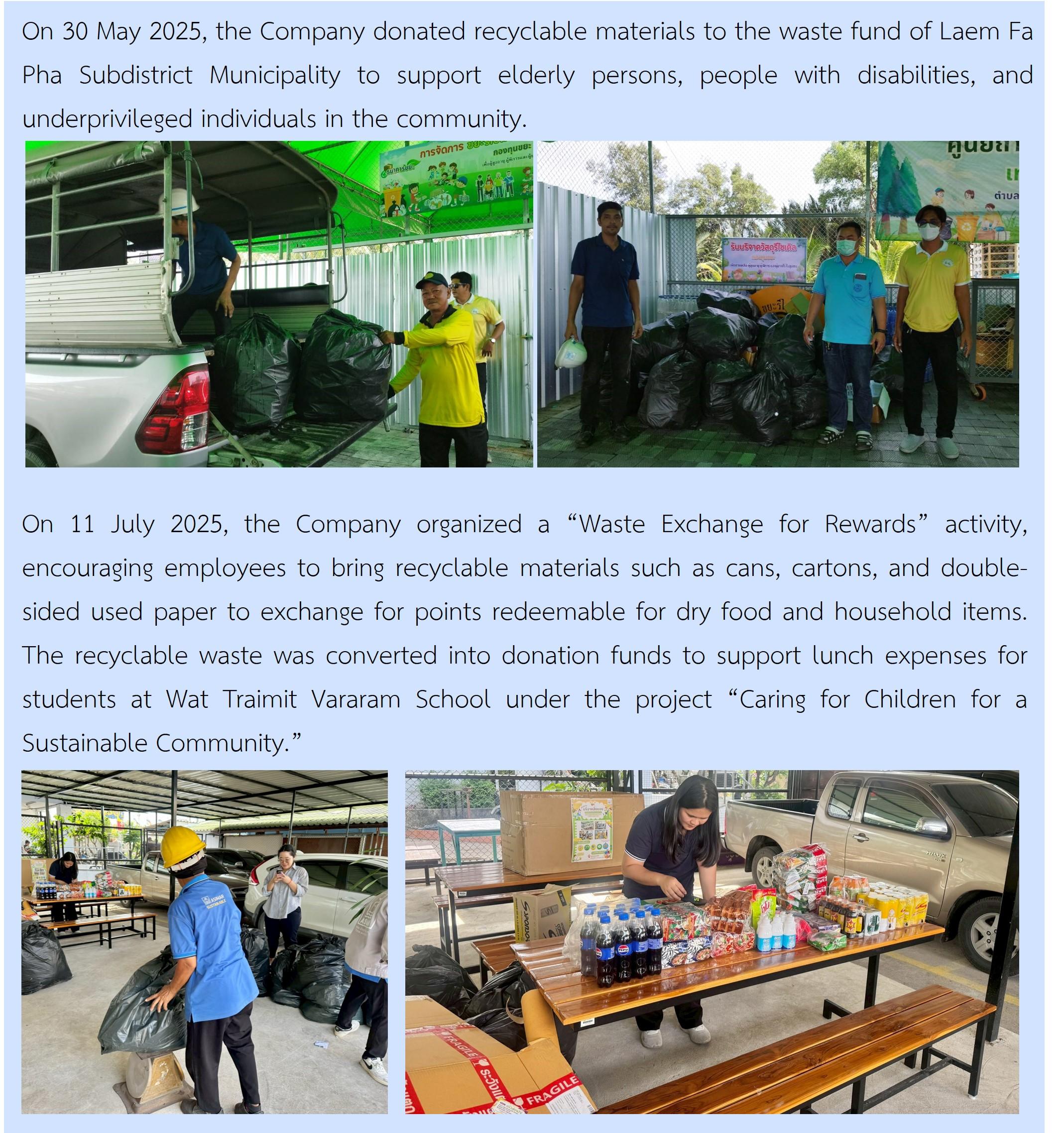
Waste Exchange for Rewards Program
The Company organized a “Waste Exchange for Rewards” program to encourage employees and contractors to properly segregate waste by category. Segregated waste can be exchanged for points or various benefits. This activity helps raise awareness of proper waste management, reduce the amount of waste requiring disposal, and increase the utilization of recyclable materials.
3R Activities (Reduce, Reuse, Recycle)
The Company implements segregation of residual materials generated from production processes and provides designated areas for storing materials by category, such as metal scraps, wood scraps, and other materials. These materials are either reused in operational processes or sent for recycling, thereby reducing the use of new resources, minimizing waste generation, and improving overall resource efficiency.
Recyclable Waste Donation Program
The Company donates recyclable waste to the waste fund of Laem Fa Pha Subdistrict Municipality for recycling and further utilization. This initiative also supports community waste management and helps create shared value with society.
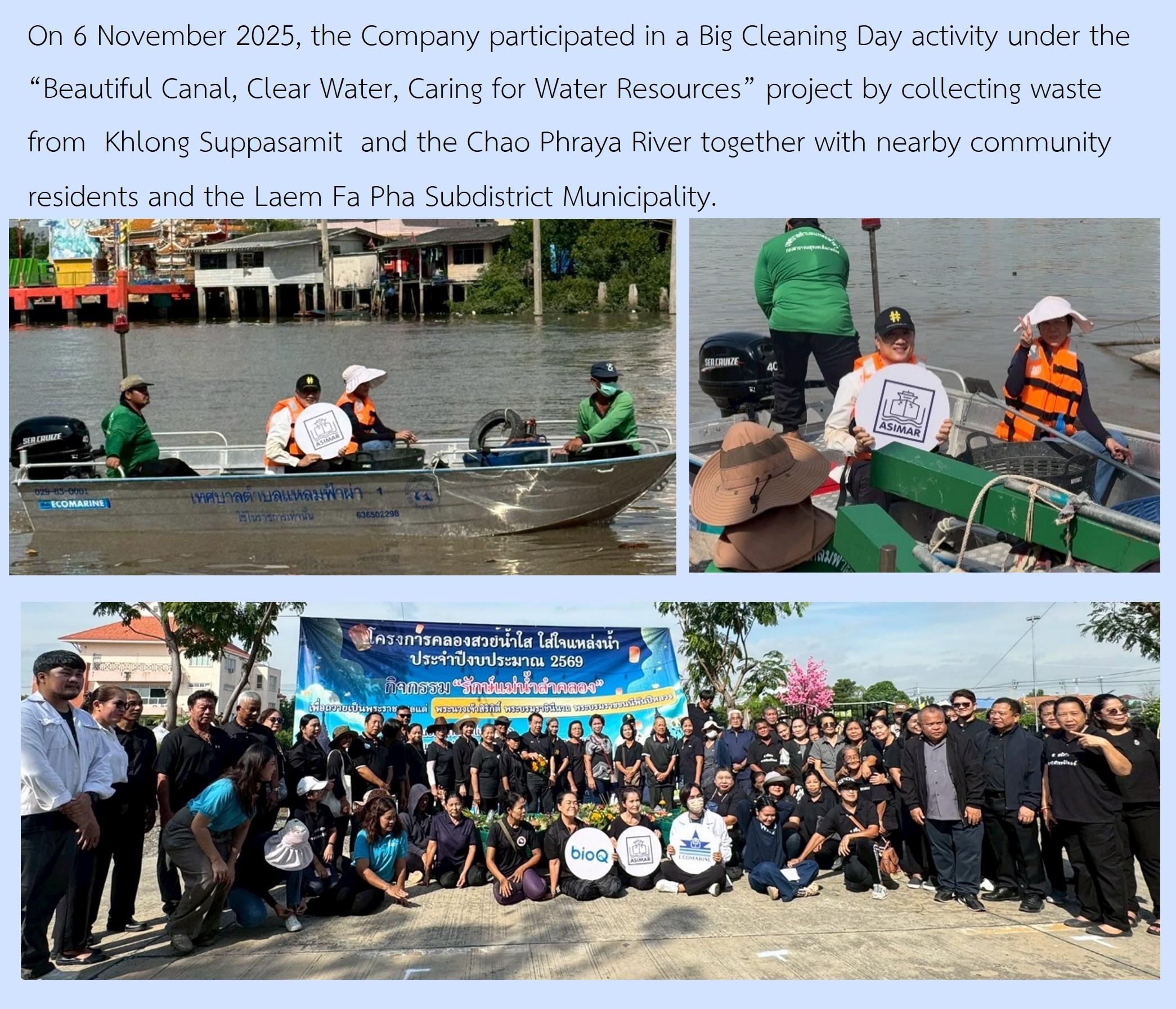
Big Cleaning Day: “Beautiful Canal, Clear Water, Caring for Water Resources”
The Company collaborated with employees, nearby community members, and Laem Fa Pha Subdistrict Municipality to organize a cleanup activity along Khlong Suppasamit and the Chao Phraya River. The activity aimed to reduce water pollution, restore the local environment, and promote cooperation in protecting natural resources in the area.
Supporting Community Innovation in Waste Utilization
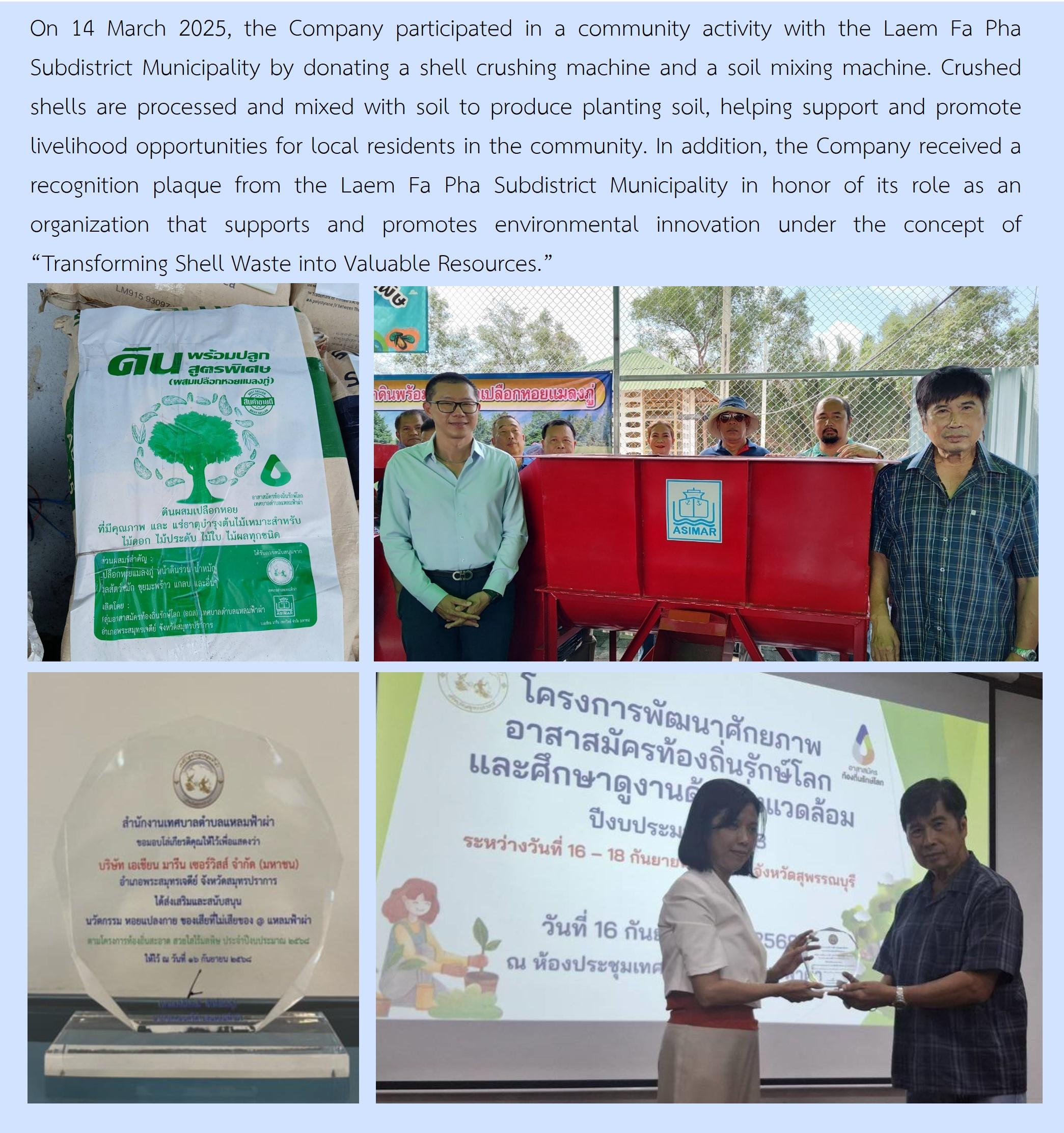
The Company participated in activities with Laem Fa Pha Subdistrict Municipality by supporting a shell crushing machine and a soil mixing machine. These machines are used to process discarded shells into crushed material that can be mixed with soil for planting trees. This initiative helps add value to waste materials, reduce the volume of waste, and support livelihood opportunities for local residents under the concept of “Transforming Shell Waste into Valuable Resources.”As a result of these initiatives, the Company received a recognition plaque from Laem Fa Pha Subdistrict Municipality in recognition of its support and promotion of environmental innovation.
The Company will continue to develop initiatives aimed at reducing and utilizing waste to enhance resource efficiency, minimize environmental impacts, and achieve sustainable growth alongside society and the community.
Photographs of Waste and Waste Management Activities
GHG — Plan & Guidelines
Has a GHG Management Plan
Yes
Plan Description
Greenhouse gases are a major cause of climate change, an issue that is increasingly important to all stakeholder groups as it affects the environment, economy, and society worldwide. Rising temperatures and increasingly unpredictable weather conditions may also impact the working conditions of employees and contractors. In addition, climate change may affect the Company’s ability to deliver products and services according to planned schedules, while stricter policies and regulations related to the energy transition toward a low-carbon society continue to emerge. Therefore, the Company places strong emphasis on greenhouse gas management to support a sustainable transition toward future business operations.
To address this, the Company is committed to systematically managing greenhouse gas emissions in accordance with ISO 14064-1:2018. The Company focuses on measuring greenhouse gas emissions from all operational activities through the Carbon Footprint for Organization (CFO) approach. The collected data are analyzed to develop strategies for improving energy efficiency and reducing greenhouse gas emissions throughout the value chain. The Company implements these efforts through the “3Rs Strategy”, as follows:
GHG Accounting (Measure & Identify) The Company prepares a comprehensive greenhouse gas inventory covering both direct emissions (Scope 1) and indirect emissions (Scope 2 and Scope 3) in order to identify significant emission sources.
Emission Reduction (Reduce: Efficiency & Innovation) The Company drives greenhouse gas reduction initiatives through two key mechanisms:
Energy Efficiency Improvement: Optimizing the management and operation of machinery and equipment used in shipbuilding and ship repair processes to ensure efficient energy utilization.
Transition to Clean Energy: Studying and gradually adopting renewable energy to reduce reliance on fossil fuels, such as initiating the transition toward the use of electric vehicles (EVs) in Company operations and implementing energy-saving technologies in production processes.
Reporting and Transparency (Report: Transparency & Verification) The Company places transparency at the core of its operations by openly disclosing its energy management approaches and performance to stakeholders. In addition, the Company undergoes external verification to obtain certification in accordance with ISO 14064-1:2018, demonstrating the accuracy of the data and the Company’s commitment to international standards of social and environmental responsibility.
GHG — Emissions
GHG Emissions
| Metric | Current Year | Previous Year | Two Years Ago |
|---|---|---|---|
| Total GHG emissions (Metric tonnes of carbon dioxide equivalent) | 9,539 | 11,051 | 0 |
| Total greenhouse gas emissions 1 (Metric tonnes of carbon dioxide equivalent) | 468 | 442 | |
| Total greenhouse gas emissions 2 (Metric tonnes of carbon dioxide equivalent) | 1,536 | 2,145 | |
| Total greenhouse gas emissions 3 (Metric tonnes of carbon dioxide equivalent) | 7,535 | 8,464 |
GHG — Emissions Verification
Emissions Verified by a Third Party
Yes
Verifying Body
2649
Verification Document Link
https://eonemedia.setlink.set.or.th/report/0544/2025/1772672576609.pdf
GHG — Principles & Standards
Principles & Standards Applied
| Standard |
|---|
| 2677 |
GHG — Targets
Has Set GHG Targets
Yes
GHG Targets — Other Targets
Other GHG Targets
| Emission Scope | Base Year | Base Year Emissions | Near-term Target Year | Near-term Target Change (%) | Long-term Target Year | Long-term Target Change (%) | Target Year | Target Change (%) | Unit |
|---|---|---|---|---|---|---|---|---|---|
| 2715 | 2,024 | 2,587 | 2,027 | 1 | 2,029 | 2 | 2,027 | 1 | Metric tonnes of carbon dioxide equivalent |
GHG — Performance & Outcomes
Has Performance Results
Yes
Performance Description
In 2025, the Company obtained certification under the international standard ISO 14064-1:2018 covering Scope 1, Scope 2, and Scope 3 emissions. The Company received certification for the Carbon Footprint for Organization (CFO) on 28 February 2025 following verification by an external verifier from the ISO Certification Institute.
In addition, the Company improved the efficiency of its production processes to reduce energy consumption and energy loss through the following initiatives:
Improving the water pump system within the shipyard to enhance pump operating efficiency.
Replacing two boom lifts powered by internal combustion engines with electric boom lifts.
Implementing a project to relocate the main electrical supply for the fabrication workshop and machine shop to improve energy cost efficiency. The main electrical supply of the fabrication building was connected to an electricity tariff structure that is more appropriate and aligned with the actual energy consumption patterns of the production process.
In 2025, the Company recorded no cases of legal violations or environmental impact incidents related to environmental regulations.
Environmental Legal Incidents
Legal Violation Incidents
| Metric | Current Year | Previous Year | Two Years Ago |
|---|---|---|---|
| Number of cases or incidents of legal violations or negative environmental impact (cases) | 0 | 0 | 0 |
Other Environmental Management
Plan Description
Pollution and Waste Management
1.Air Pollution Management
The company has established procedures for air pollution management outlined in the "Air Control" operating procedures. Actions include the installation of dust barriers, a water spray system in work areas, and the use of high-pressure water sprayers (Hydrobrast) to prevent the dispersion of dust, prevent sand particles from falling into the river, and reduce the potential impact on surrounding communities. Additionally, measures are in place for air quality monitoring in community areas every 6 months and health checks for employees and contractors annually to minimize the impact on stakeholders and the environment.
Performance Results In 2025
In 2025, the Company’s performance in pollution and waste management indicated that there were no written complaints from government authorities throughout the year. However, the Company received one suggestion from the local community regarding sand dust generated from operational processes. The Company subsequently improved its operational procedures and enhanced monitoring measures. Environmental quality monitoring was conducted twice during 2025, and the results confirmed that all environmental quality parameters complied with the standards prescribed by law.
2.Hydrocarbon Spills
The company is aware of the impacts of oil spills, which can cause economic, social, and environmental consequences, including effects on the health and safety of employees, communities, contamination of soil, and water sources in the affected area. Therefore, the company is committed to reducing the risk of spills and has implemented measures and procedures to effectively handle emergency spill incidents, covering the entire value chain. The company reports performance results to the management team on a monthly basis and continuously reviews and evaluates risks every 6 months.
Performance Results In 2025
As a result of the Company’s measures to prevent and manage oil and chemical spills within its operational areas, no significant oil or chemical spills were recorded. This has strengthened confidence in operational safety and environmental protection among the surrounding community. Monitoring results also confirmed that there were no significant leakages from production processes.
Employees — Plan & Guidelines
Introduction
The company places great importance on its personnel, who are its most valuable resource. The company recognizes and is committed to building and developing its workforce to be prepared and capable of conducting business in the present day, which faces intense competition and volatility amidst rapidly changing environmental factors. The company has therefore established sustainable human resource development policies and plans to achieve business leadership and service excellence at the international level. In addition, the company recognizes the importance of systematic employee training. The company has assigned the Human Resources Department to be responsible for developing personnel to have the knowledge and abilities to be a key force in driving the business to achieve effective results. This is done by developing the workforce in line with the current situation, along with a commitment to conducting business that can grow sustainably, adapt to economic changes, and align with competitive advantages through innovation and creativity.
Therefore, the company has created and developed a system for recruiting and retaining talented employees. The company is committed to continuously developing and enhancing the capabilities of its employees, promoting opportunities for advancement and career stability, and treating all employees equally.
Has an Employee Management Plan
Yes
Plan Description
Fair Employee Compensation
The Company has established remuneration policies that offer appropriate remunerations to employees on all levels and are competitive with those of other companies in the same industry with adherence to fair and equitable compensation practices. Each job is appropriately assigned to a pay grade that represents employees performing similar work in the compensation structures. The performance management system : PMS used as an administrative compensation, succession plan, and advancement
The Company determines compensation in alignment with the Company’s short- term and long-term operating results. In the short term, the annual operating results such as, net profit will be factored into the equation. In the long term, the Company’s long-term comparatives including profit growth, overall operating results and ongoing operational enhancement are taken into consideration.
Welfare Arrangement
The Company has a policy of providing appropriate benefits to its employees. The Company regularly reviews its benefits package to ensure it aligns with the changing economic and social conditions.
Employee Training and Development
The Company continuously develops its personnel by conducting annual training needs surveys for various departments. Once the needs are identified, an annual training plan is developed, providing both internal and external training to employees to enhance their knowledge, abilities, and work efficiency. The Company has a systematic and continuous personnel development process that covers employees in all target groups and provides adequate budget support for personnel development. This is defined as an annual training plan, and employees are required to attend training according to the plan. It is set as a KPI and is part of the annual performance evaluation. Employee Potential Development
Employee engagement and retention
The company has plans to build employee engagement through the company's various relations activities. By taking suggestions from employees into consideration and taking corrective actions. When corrections are made according to the suggestions, the company are communicated to employees to be informed of the suggestions that have been corrected. or communicate how the company plans to take corrective action in the future including listening to opinions through Communications Committee meeting which is a committee that represents employees to bring opinions to develop various systems together.
Safety, Occupational Health and Working Environment
The Company prioritizes the safety of its employees, contractors, and stakeholders as the top priority in safety management with the concept of "All employees and contractors leave home, come to work, and return to their families safely."
The Company prioritizes occupational health and safety as crucial aspects of its business operations. The Company communicates to employees at all levels, contractors, and relevant individuals to ensure their understanding and appropriate implementation. Therefore, the Company has established an occupational health and safety policy to guide its operations in this area. The Company is committed to creating a safety, occupational health, and work environment culture under the ISO 45001: 2018 standard and compliance with legal requirements, based on sustainability, to create positive changes in workplace safety and the work environment. This includes promoting awareness of safety, occupational health, and the work environment among the Company's employees, contractors, customers, and stakeholders, as well as establishing measures to mitigate impacts through effective training, knowledge development, and communication processes.
Plan Areas
| Plan Area |
|---|
| Fair employee compensation |
| Employee training and development |
| Promoting employee relations and participation |
| Occupational health and safety in workplace |
Employees — Workforce
Employees with Disabilities — Introduction
The Company supports social inclusion and provides opportunities for disadvantaged individuals in order to promote their value and potential in society. The Company employs disadvantaged individuals and persons with disabilities in full compliance with the requirements stipulated by law.
Workforce Data
| Metric | Current Year | Previous Year | Two Years Ago |
|---|---|---|---|
| Total number of employees (Persons) | 506 | 532 | 481 |
| Number of male employees (Persons) | 419 | 440 | 405 |
| Number of female employees (Persons) | 87 | 92 | 76 |
| Total employment of disabled persons (people) | 5 | 3 | 3 |
| Total disabled employees (people) | 5 | 3 | 3 |
| Total male disabled employees (people) | |||
| Total female disabled employees (people) | |||
| Total disabled workers who are non-employee (people) | |||
| Contributions to the fund for promoting and improving the quality of life for disabled persons | 0 | 1 | 1 |
| Total number of male employees in operational level (Persons) | 386 | 404 | 374 |
| Total number of male employees in management level (Persons) | 30 | 33 | 28 |
| Total number of male employees in executive level (Persons) | 3 | 3 | 3 |
| Total number of female employees in operational level (Persons) | 75 | 81 | 66 |
| Total number of female employees in management level (Persons) | 10 | 9 | 8 |
| Total number of female employees in executive level (Persons) | 2 | 2 | 2 |
Employees — Remuneration & Provident Fund
Remuneration & Provident Fund
| Metric | Current Year | Previous Year | Two Years Ago |
|---|---|---|---|
| Total disabled employees (people) | 174,690,000 | 156,782,000 | 124,146,000 |
| Total male employee remuneration (Baht) | |||
| Total female employee remuneration (Baht) | |||
| Number of employees eligible to participate in PVD (persons) | 495 | 518 | 474 |
| Total number of employees joining employee provident fund (Persons) | 301 | 298 | 279 |
| Percentage of total number of employees joining employee provident fund to total number of employees (%) | 59.49 | 56.02 | 58 |
| Number of PVD members / Total eligible employees (%) | 60.81 | 57.53 | 58.86 |
| Total amount of provident fund contributed by the Company (Baht) | 5,634,126.2 | 5,153,532.48 | 4,832,400.7 |
| Total amount of provident fund contributed by employee (baht) |
Employees — Training & Development
Training Data
| Metric | Current Year | Previous Year | Two Years Ago |
|---|---|---|---|
| Average employee training hours (Hours / Person / Year) | 6 | 6 | 6 |
| Employee development and training expenses (baht) | 1,440,000 | 1,500,000 | 435,000 |
Employees — Occupational Health & Safety
Occupational Health & Safety Data
| Metric | Current Year | Previous Year | Two Years Ago |
|---|---|---|---|
| Total number of lost time injury incidents by employees (Cases) | 9 | 11 | 11 |
Employees — Labour Relations
Labour Relations Data
| Metric | Current Year | Previous Year | Two Years Ago |
|---|---|---|---|
| Total voluntary resignations (Persons) | 59 | 62 | 92 |
| Male employees who voluntary resigned (Persons) | 46 | 50 | 78 |
| Female employees who voluntary resigned (Persons) | 13 | 12 | 14 |
| Percentage of employee turnover leaving the Company voluntarily (%) | 11.66 | 9.59 | 19.13 |
| Evaluation result of employee engagement | 1 | 1 | 1 |
Employees — Employee Representation
Employees Are Represented Collectively
Yes
Forms of Representation
| Form | Other — Please Specify |
|---|---|
| Others | Safety Committee, Occupational Health and Safety |
| Welfare committee |
Employees — Targets
Has Set Employee Targets
Yes
Targets
| Indicator | Target Areas | Base Year | Base Year — Description | Target Year | Target Year — Description |
|---|---|---|---|---|---|
| Employee satisfaction or engagement | 2985 · Description: Promoting employee relations and participation | 2,024 | Employee satisfaction or engagement score: 71.73% | 2,025 | Employee satisfaction or engagement scores have increased by 0.50% from the baseline year. |
| The number of incidents resulting in more than 3 days of work stoppage must be zero. | 2988 · Description: Safety and occupational health at work | 2,025 | The number of incidents resulting in more than 3 days of work stoppage must be zero. | ||
| Number of individuals with abnormal health check-up results at risk | 2988 · Description: Safety and occupational health at work | 2,024 | The number of individuals at risk of abnormalities based on current health screening is 3. | 2,025 | The number of individuals identified with health concerns from current health screenings should not exceed the figures from the preceding period. |
Employees — Performance & Outcomes
Has Performance Results
Yes
Performance Description
Indicators | Targets for 2025 | Performance in 2025 |
Employee satisfaction or engagement | Employees satisfaction or engagement scores have increased by 0.50% from the baseline year | 78.18% (increase of 6.45%) |
The number of incidents resulting in more than 3 days of work stoppage must be zero. | The number of incidents resulting in more than 3 days of work stoppage must be zero. | 6 cases |
Number of individuals with abnormal health check-up results at risk | The number of individuals identified with health concerns from current health screenings should not exceed the figures from the preceding period. | 0 cases |
Employee Compensation
In 2025, the company has total remuneration of employees equal to 174.69 million baht, which is in the form of salary, wages, overtime pay, medical expenses. health insurance premiums Contributions to the Workmen's Compensation Fund Contributions to the Social Security Fund Contributions to provident funds and other welfare expenses The remuneration for male employees is 78% and the remuneration of female employees is 22%.
Welfare
The company has a policy of providing appropriate welfare to its employees. The company regularly reviews its various welfare programs to ensure that they are in line with the changing economic and social conditions, such as:
• Establishment of a provident fund For long-term employee care, there are currently 301 employees of the Company and its subsidiaries who have joined the Provident Fund out of a total of 495 eligible employees, representing 61%. The Fund is managed by TISCO Asset Management Company Limited.
• Setting up a medical welfare scheme (in addition to Social Welfare entitlements)
• Employee uniforms and Personal Protective Equipment (PPE).
• Creating the Asian Marine Services Employees’ Savings Cooperatives. At present, the company and its subsidiaries have 183 employees, accounting for 36% of the cooperative members. Cooperatives help employees by providing higher deposit rates than commercial banks and preferential interest rate loans for cooperative members.
• Granting scholarships to employees’ children who are good students.
• Provide scholarships for employees who want to continue learning
• Providing annual medical check ups for staff
• Providing transport to employees to and from work
• Appointing a staff relations committee to look after staff welfare, and providing a channel for communication so that staff have the opportunity to make suggestions or complaints via a comments and suggestions box.
• Occupational Health and Safety Committee has also been set up to handle workplace health and safety
Employee Training and Development
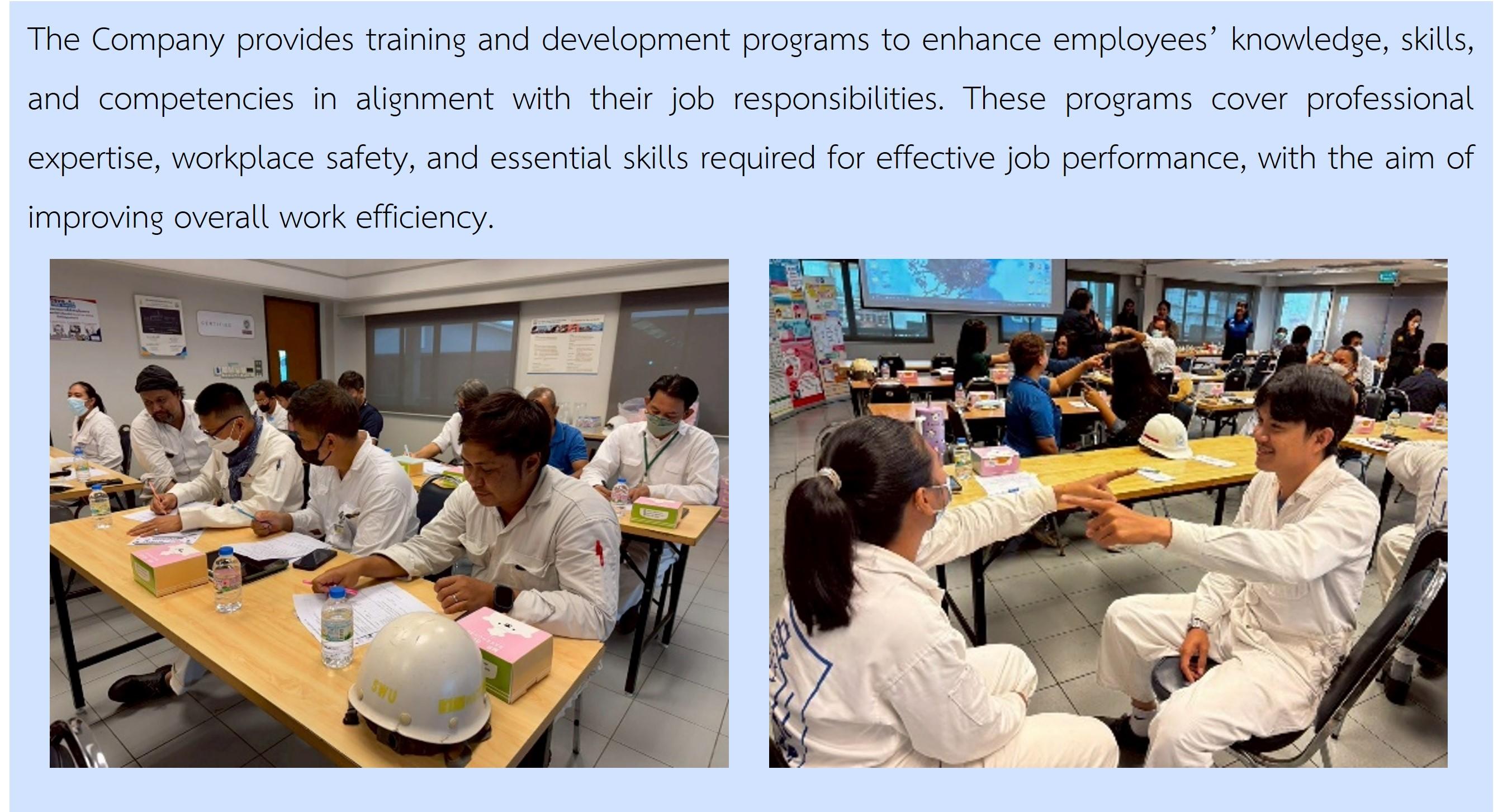
In 2025, the company provided training to employees for an average of 6 hours/person/year with a training and expenses for training and development in the amount of 1.44 million baht. The company also followed up on the application of knowledge through employee interviews.
The company has a training unit that will survey employees' needs in order to plan an annual training program, which includes both internal and external training personnel. The training can be divided into 4 types:
1. Fundamental Skill such as new employee orientation, English and computer fundamentals, shipyard safety systems and operational standards, etc.
2. Technical Skill such as welders and metal fabricators, Skills in using mechanical gauges and Skills in using hand tools, etc.
3. Management for example, techniques that emphasize leadership and command, presentation techniques and quality systems ISO 9001, occupational health and safety systems ISO 45001, and environmental management systems ISO 14001, etc.
4. Special Skill such as scuba diving courses, ship repair management, working in confined spaces, working in hot sparks and working at heights, etc.
Examples of internal training topics for 2025
Personal Data Protection Act (PDPA) B.E. 2562 (2019) – 6 hours
Building High-Performing Teams (Growth Mindset) – 6 hours
Professional Negotiation Skills – 6 hours
Self and Time Management / Performance Feedback and Coaching – 6 hours
Leadership Communication – 6 hours
High Impact Presentation – 6 hours
Outward Mindset for Success – 6 hours
Business Ethics (Code of Conduct) – 6 hours
Welding Training Program (Welding School) – 84 hours
Ship Knowledge – 6 hours
Cybersecurity Awareness – 6 hours
Excel for Workplace Efficiency – 6 hours
Ultrasonic Testing Level II – 6 hours
Hazardous and Non-Hazardous Waste Management in Compliance with Legal Requirements – 6 hours
Introduction to ESG and the Role of the CFO – 6 hours
Professional Project Management – 6 hours
Effective Communication Skills for Section Heads – 6 hours
Leadership Skills for Supervisors – 6 hours
Employee engagement and retention
In 2025, the Company conducted a survey of employees' satisfaction and engagement with the organization and gave employees the opportunity to express their opinions about the Company. in order to develop the quality of taking care of employees to be thorough The evaluation results are at 78.18% and There are employees who voluntarily resign from their jobs 12% In 2025, there were no significant labor disputes.
Safety, Occupational Health and Working Environment
In 2025, the company has established a safety management policy: Safe Work, Zero Accidents at Work/No Occupational Diseases. The targets and results are as follows:
In 2025, the Company established its occupational safety policy with the objective of achieving zero work-related accidents and no occupational illnesses. The targets and performance outcomes are as follows:
The number of incidents resulting in more than three days of work stoppage must be zero.
In 2025, there were 6 incidents resulting in more than three days of work stoppage (target: 0 incidents).The number of employees with abnormal health screening results related to occupational risk factors must not increase from the previous year (3 cases in 2024).
In 2025, no new cases of abnormal health screening results related to occupational risk factors were identified.
The Company has implemented preventive measures to reduce workplace accidents by requiring all employees to wear appropriate personal protective equipment (PPE) at all times while performing their duties. In addition, the Company provides safety training programs, including safety training for new employees and contractors, working at height, confined space operations, occupational safety, health and working environment, and fire evacuation training.
In 2025, has been an incident with a staff of 9.
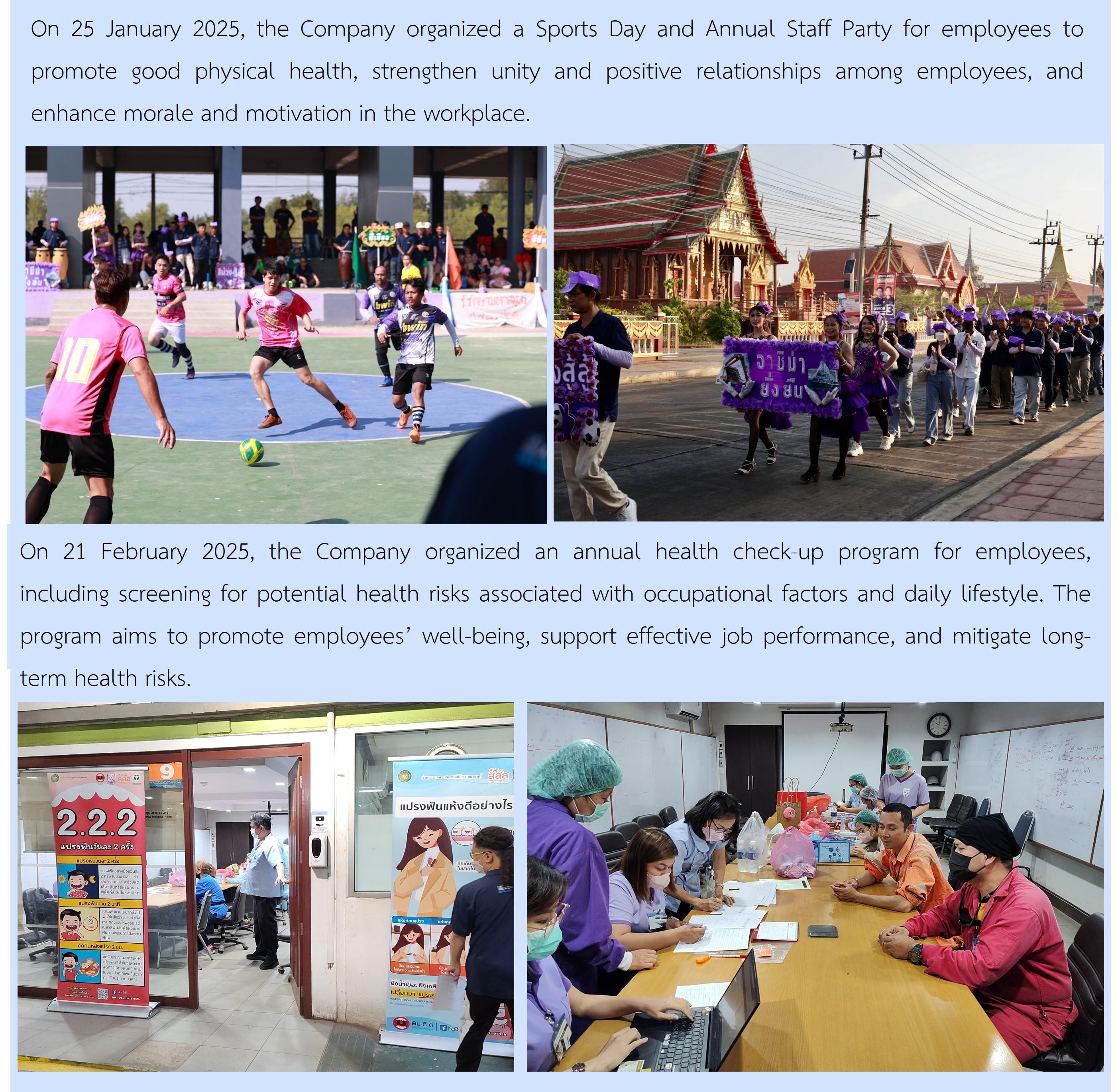
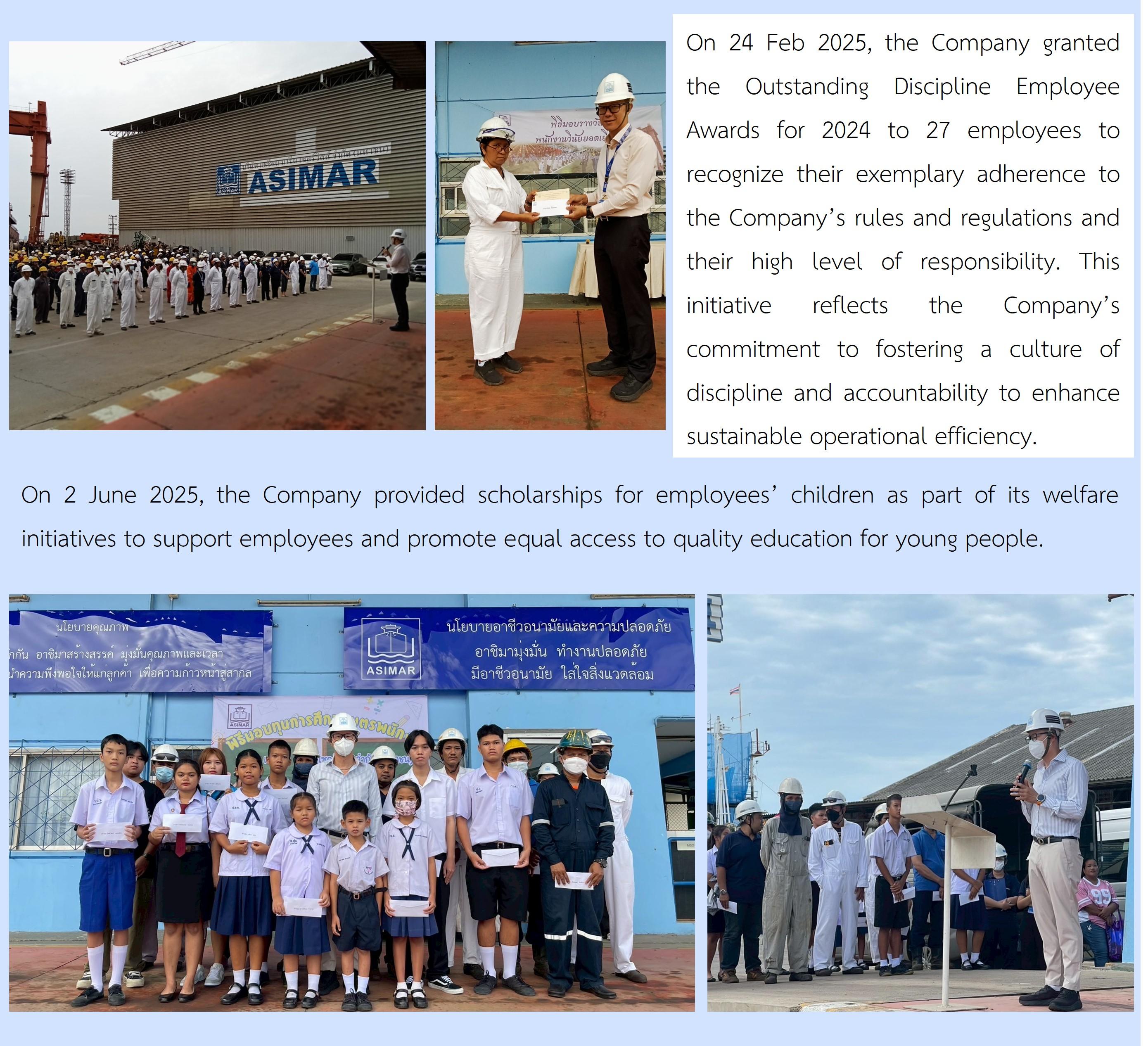
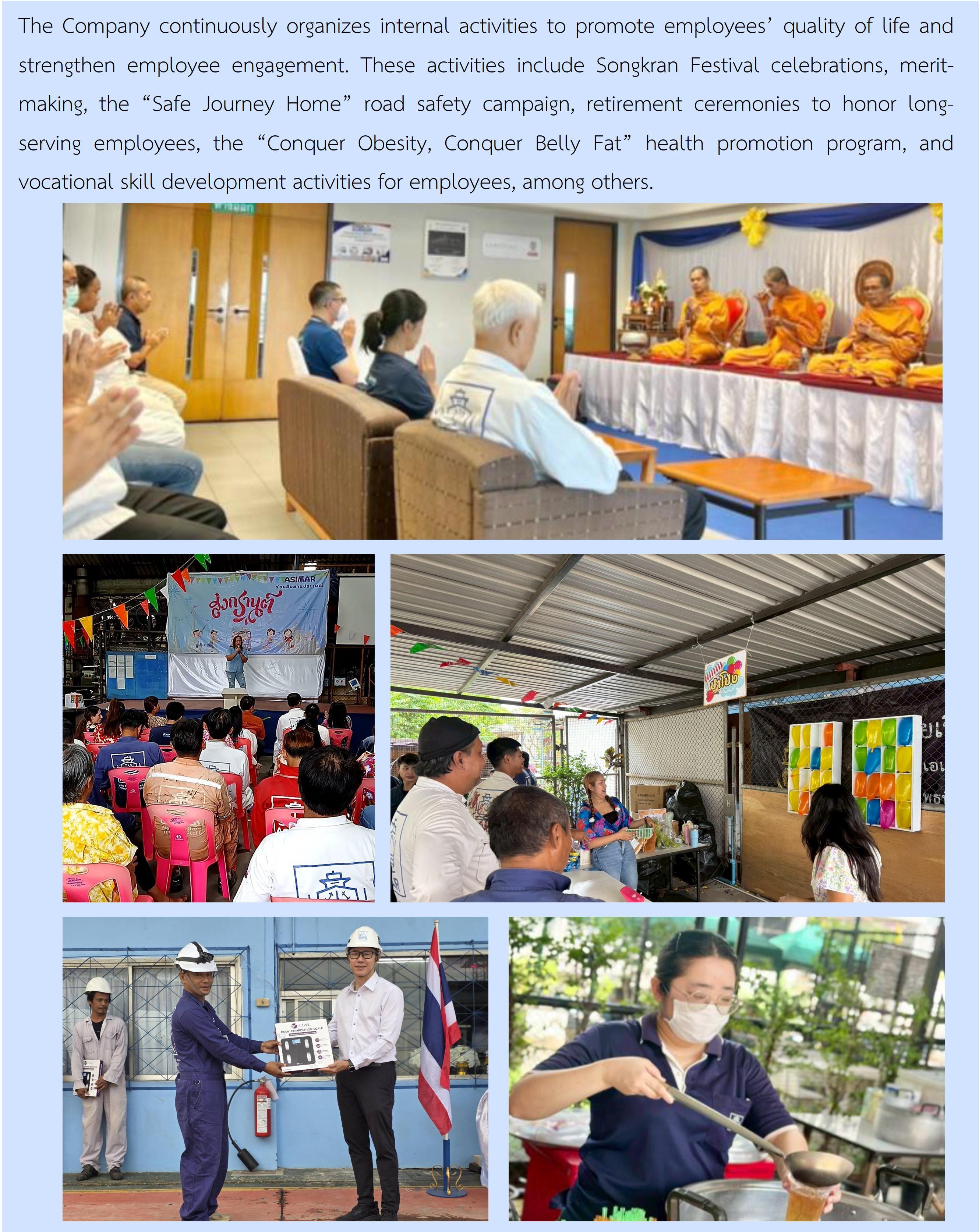
Diagram of performance and outcomes for employee and labor management
Customers — Plan & Guidelines
Introduction
The company focuses on creating positive experiences for customers and potential customers throughout their entire journey. This begins with analyzing customer behavior and expectations (Customer Expectation), defining clear objectives (Customer Experience Identify), and understanding the customer journey (Customer Journey). We have processes to gather customer insights and use them to improve operational procedures and enhance the quality of our service staff. This includes measuring the results of our customer experience initiatives and ensuring the security of customer data to prevent breaches. All of this contributes to a strong relationship between the company and its customers, reduces potential complaints, increases repeat purchases, boosts revenue, and builds a positive brand image for the company.
Has a Customer Management Plan
Yes
Plan Description
Responsible production and services for customers
Quality work process
The Company is committed to providing good, fast, and quality service. Throughout the past until now, we are committed to repairing and building quality ships with the goal of being a leader in modern products, fast service, quality control, meeting customer needs under the ISO 9001: 2015 quality management system standard, quality control to meet the standards of the International Association of Classification Society (IACS), and customer requirements.
Communication of product and service impacts to customers/consumers
Responsible Marketing Communications Policy
The Company has established a Responsible Marketing Communications Policy to guide the Company's marketing communications to ensure that our communications are accurate, transparent, fair, and considerate of the impact on society, consumers, and the environment. This covers communications across all channels, including online media, print media, television, radio, and various sales promotion activities to help enhance the image and differentiate the Company's products from competitors. However, the Company remains committed to ethical, responsible, and fair marketing practices to consumers. There is no unethical communication, false, misleading, exaggerated, or other information that may adversely affect society both in the short and long term. At the same time, the Company has various channels for receiving complaints or information from customers/consumers through questionnaires, email, and telephone.
Development of customer satisfaction and customer relationship
Customer Satisfaction Policy and Development
In addition to measuring the Company's annual performance, the Company also aims to create satisfaction for customers who use the service in order to improve and enhance service standards to achieve the highest level of impression and satisfaction. A customer satisfaction questionnaire is conducted, with service users emphasizing work quality and timely delivery for each repair order. It also evaluates the convenience of work supervision and coordination of the marketing department. A scoring system is used as a standard criterion to bring the evaluation scores of each customer to plan for improvement and development.
Customer Policy and Practice
The Company focuses on conducting business fairly and equitably, offering quality services and creating customer satisfaction by conducting satisfaction surveys of all customers who bring their ships in for service or opening channels for complaints through the Executive Secretary. Meetings are held to consider and analyze the satisfaction scores at least once a month.
Customer Personal Data Protection
The Company recognizes the importance of privacy and the protection of personal data of all stakeholders. To ensure that such personal data is protected and prevented from being at risk of damage to the fullest extent possible, the Company has established a policy and guidelines for personal data management and security measures to ensure business continuity, as detailed below.
Collection, Use, and Disclosure of Personal Data: The Company must obtain explicit consent from the owner of the personal data, including sensitive information. In the case of visitors to the Company's website, it is deemed that the individual has consented to the collection of personal data.
The Company has measures to protect, safeguard, and retain personal data for a specified period of time, using appropriate measures to maintain the accuracy, up-to-dateness, and reliability of personal data to prevent unauthorized destruction, alteration, and access.
Personal data that exceeds the Company's specified retention period, or the Company no longer has the right or cannot claim a basis for processing the personal data of the data subject, the Company will proceed to destroy such personal data.
Provide channels for receiving requests to exercise the rights of personal data subjects through the channels specified by the Company.
Plan Areas
| Plan Area |
|---|
| Responsible production and services for customers |
| Communication of product and service impacts to customers/consumers |
| Development of customer satisfaction and customer relationship |
| Protection of customer personal information |
Customers — Satisfaction Results
Customer Satisfaction Results
| Metric | Current Year | Previous Year | Two Years Ago |
|---|---|---|---|
| Evaluation results of customer satisfaction | 1 | 1 | 1 |
Customers — Targets
Has Set Customer Targets
Yes
Targets
| Indicator | Target Areas | Target Year | Target Year — Description |
|---|---|---|---|
| Number of customer claims | 3007 · Description: Responsible production and services for customers · 3009 · Description: Development of customer satisfaction and customer relationship | 2,025 | The number of customer claims is zero. |
| Annual average from customer satisfaction survey | 3009 · Description: Development of customer satisfaction and customer relationship | 2,025 | The average annual customer satisfaction score was 92 percent in 2023. |
| Number of initial complaints received from key account customers | 3007 · Description: Responsible production and services for customers · 3009 · Description: Development of customer satisfaction and customer relationship | 2,025 | There are identified complaints representing genuine problems from existing customers within the key customer group, along with clear guidelines for addressing those complaints. |
Customers — Performance & Outcomes
Has Performance Results
Yes
Performance Description
Indicators | Target for 2025 | Performance in 2025 |
Number of customer claims | The number of customer claims is zero. | Zero customer quality complaints were reported in 2025. |
Annual average from customer satisfaction survey | The average annual customer satisfaction score was 92 percent in 2023. | The average customer satisfaction score was 96% in 2025, exceeding the target. |
Number of initial complaints received from key account customers | There are identified complaints representing genuine problems from existing customers within the key customer group, along with clear guidelines for addressing those complaints. | The Company continuously monitored and reviewed complaints from key existing customers. No material complaints affecting customer satisfaction were identified. Nevertheless, the Company has established a clear feedback and complaint response process to address any potential issues in the future. |
Responsible production and services for customers
Quality work process
In the past year 2025, the company has managed and controlled quality, resulting in no customer claims in the past year. The company is also committed to delivering quality products and services that meet customer needs continuously.
Development of customer satisfaction and customer relationship
In 2025, the company had an average customer satisfaction score for each month that passed the standard of 92 points and the company has gathered data on customers, including the number of vessels arriving at the company, the consistency of vessel arrivals, and spending patterns over the past 5 years. This data is used to determine which customers will be classified as Key Accounts, in order to analyze and find proactive problem-solving strategies. This will involve all relevant departments, both directly and indirectly involved with the customer, at every touch point of the process, to create a positive customer experience.
Communication of product and service impacts to customers/consumers
In 2025, there were no incidents or complaints related to consumer rights violations
Customer Personal Data Protection
In 2025, there were no cases of customer data breaches.
Community & Social — Plan & Guidelines
Has a Community & Social Plan
Yes
Plan Description
Responsibility to the community and society
The Company has a policy to conduct business with Corporate Social Responsibility (CSR) with awareness and emphasis on supporting social and surrounding community activities. This includes continuous environmental care and conducting business under good governance and ethical principles. We consider both internal and external stakeholders, as well as society at large, to develop a foundation for continuous and sustainable responsibility.
The Company places importance on participating in the development and promotion of the quality of life of the community and society surrounding the areas where the Company operates. This fosters a mutually beneficial coexistence between the Company, society, communities, and the environment, building relationships and sustainable coexistence for the future.
Plan Areas
| Plan Area |
|---|
| Employment and professional skill development |
| Education |
| Occupational health, safety, health, and quality of life |
Community & Social — Targets
Has Set Community & Social Targets
Yes
Targets
| Indicator | Target Areas | Target Year | Target Year — Description |
|---|---|---|---|
| Number of projects benefiting the community | 3036 · Description: Employment and professional skill development · 3039 · Description: Forests and natural resources · 3040 · Description: Sports and recreation · 3041 · Description: Occupational health, safety, health, and quality of life | 2,025 | Number of projects that make the community 1 project |
| Number of community engagement activities | 3036 · Description: Employment and professional skill development · 3039 · Description: Forests and natural resources · 3040 · Description: Sports and recreation · 3041 · Description: Occupational health, safety, health, and quality of life | 2,025 | Number of community engagement activities: 1 |
Community & Social — Performance & Outcomes
Has Performance Results
Yes
Performance Description
Indicators | Targets for 2025 | Performance in 2025 |
Number of projects benefiting the community | Number of projects that make the community 1 project | 1 project |
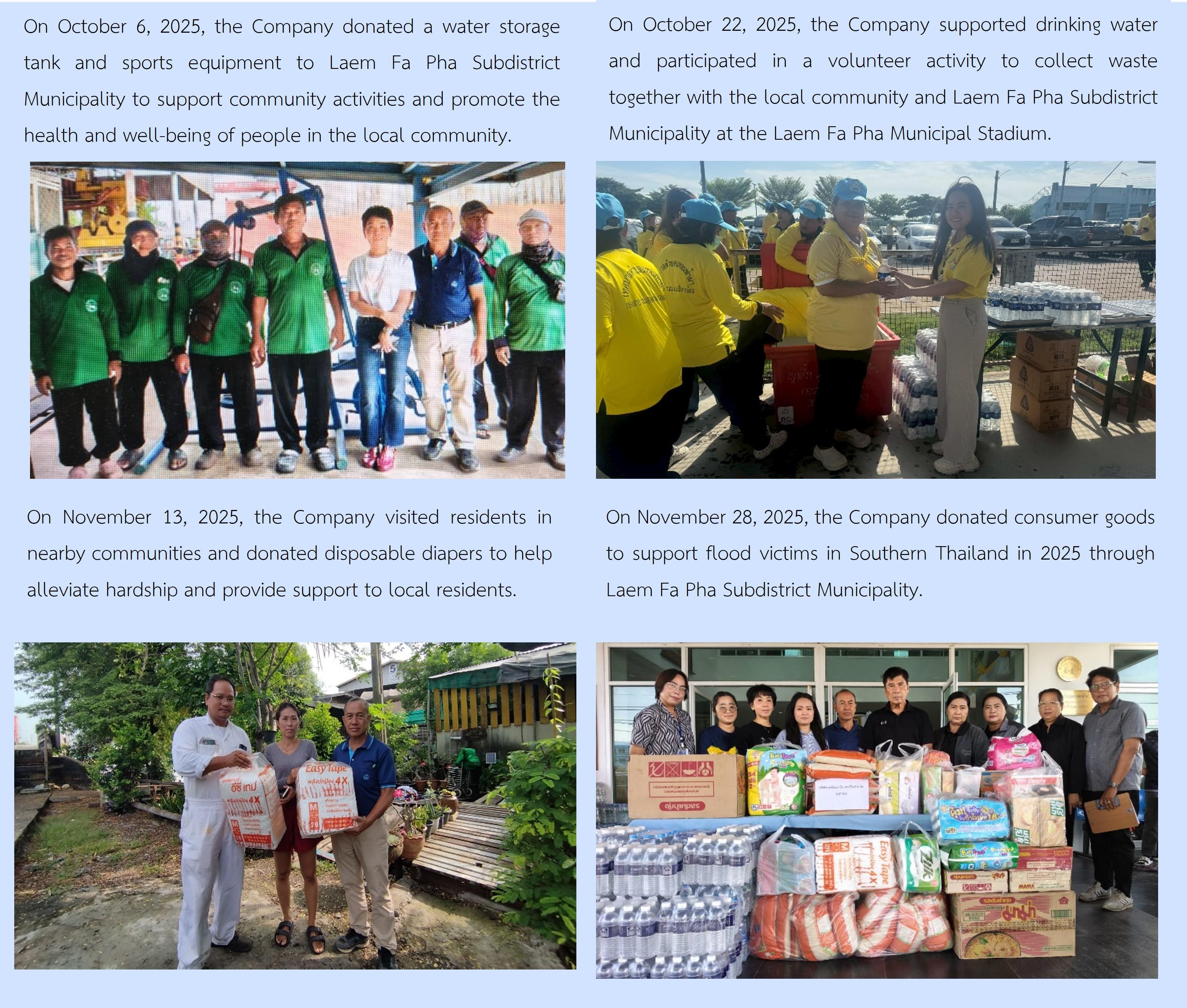
Number of community engagement activities | Number of community engagement activities: 1 | 14 activities |
Community and Social Responsibility
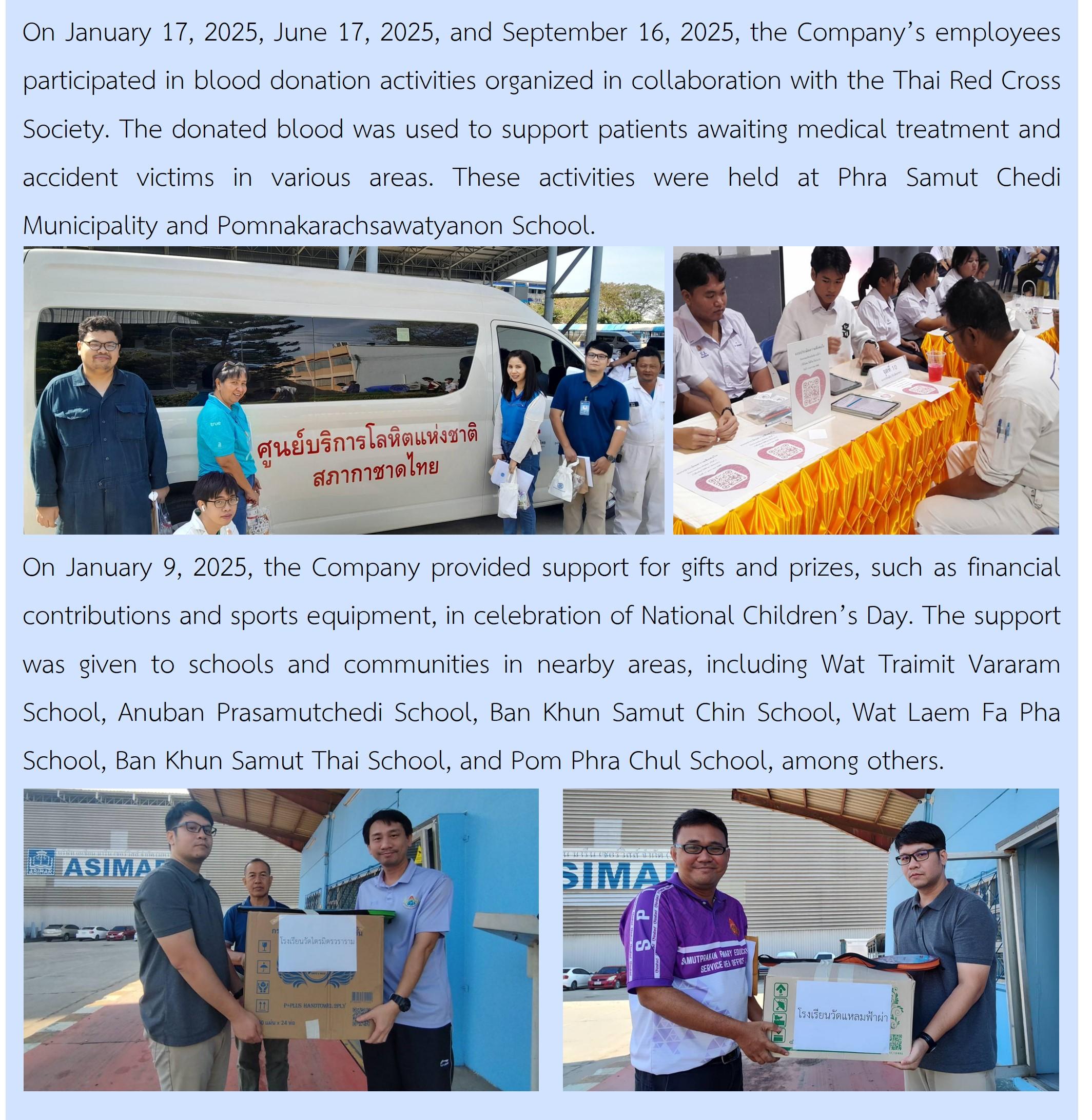
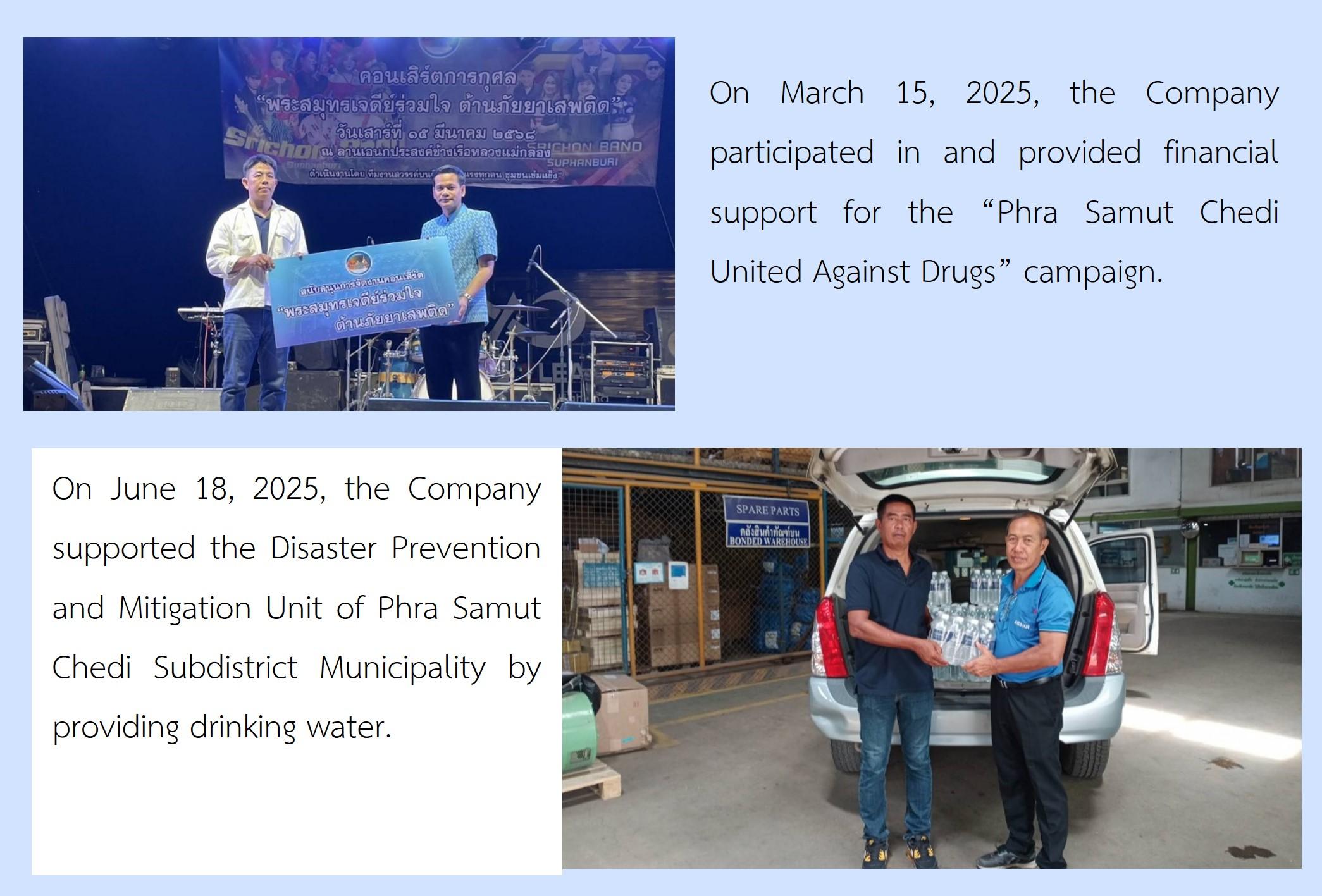
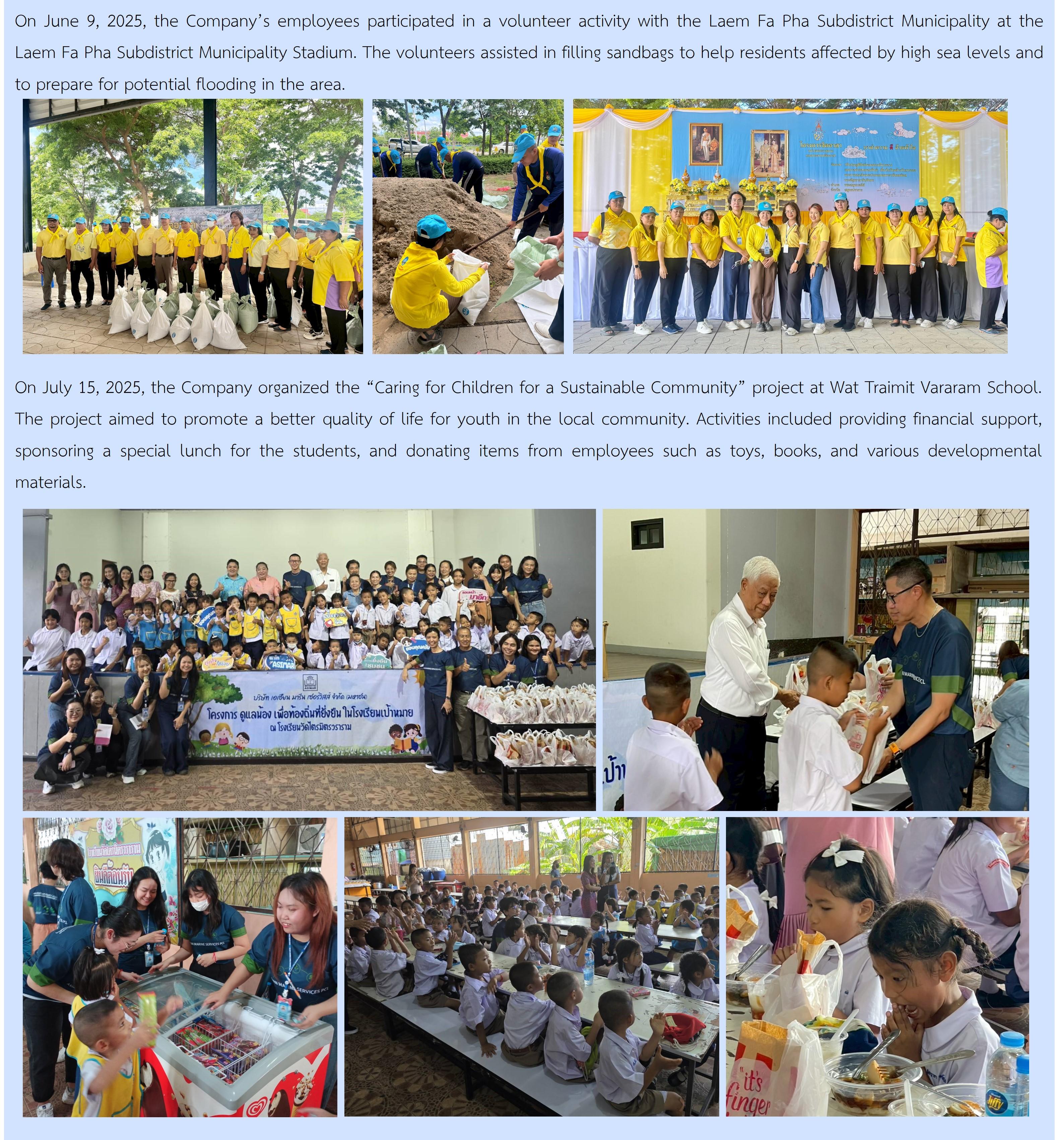
In 2025, the company had no complaints from the community and participated in various activities with the community, donating to society and supporting the community in various areas to build good relationships for sustainable coexistence.
Other Social Management
Plan & Outcomes — Description
1.Innovation and Technology
1.1Innovation
The Company places importance on using creativity, developing new inventions, or applying existing technology in work processes with the objective of creating a business advantage, enhancing long-term competitiveness, providing timely solutions to customers, and delivering value to stakeholders.
The Company has established an innovation working group and provides support in terms of budget and knowledge. The Company has also established KAIZEN AWARDS activities and set annual KPIs for employees to develop and build upon innovations or new inventions, such as work processes that reduce operating costs in terms of time, manpower, and expenses, delivering valuable value creation, as well as new products that can be expanded into commercial products that will lead to Business Model Innovation.
1.2 Technology
The Company places importance on information technology because currently, information technology has rapidly developed and played a significant role in business operations. In particular, cyber threats and personal data protection are important issues that the Company is aware of.
1.2.1 Personal Data Protection
The Company prioritizes the privacy rights and personal data protection of all stakeholders. To ensure that such personal data is protected and prevented from being at risk of damage to the least extent, the Company has established a policy and guidelines for personal data management and security measures for personal data to ensure business continuity, as follows:
• Collection, Use, and Disclosure of Personal Data: The Company must obtain explicit consent from the owner of the personal data, including sensitive information. In the case of visitors to the Company's website, it is deemed that such individuals have consented to the collection of personal data.
• The Company has appropriate measures for the protection, storage, and retention period of personal data, using appropriate measures to maintain the accuracy, up-to-date, and reliability of personal data to prevent unauthorized destruction, alteration, and access.
• Personal data that exceeds the retention period specified by the Company or for which the Company no longer has the right or cannot claim a basis for processing the personal data of the data subject, the Company will proceed to destroy such personal data.
• Provide channels for receiving requests to exercise the rights of personal data subjects through channels designated by the Company.
1.2.2 Cybersecurity
The Company is committed to protecting the security of information technology to ensure that the Company is prepared to cope with and respond to potential cyber threats appropriately and promptly, including establishing a Cyber Security Policy covering the following:
• Security Principles: Adhering to the principles of Confidentiality, ensuring that only authorized individuals can access the data, and Integrity,
• Guidelines for preventing attacks from threats: The Company has implemented technology to enhance operational efficiency and provide convenience to employees simultaneously. The Company has the following preventive measures: organizing training programs for employees to gain knowledge about cybersecurity, improving the Firewall system, and backing up data.
2.Good Corporate Governance
The Company strives to be an organization that adheres to conducting business under relevant laws, rules, and regulations to comply with good corporate governance principles, risk management, and internal control to ensure that the Company is transparent, verifiable, and has good corporate governance. The Company prioritizes meeting the needs of all stakeholders and focuses on good corporate governance along with achieving good operating results, including
Creating transparency leads to confidence in the Company's business operations from external parties, leading to sustainable growth.
The Company has partnered with the Thai Institute of Directors Association (IOD) to undergo an assessment from the Corporate Governance Report of Thai Listed Companies (CGR) project, establishing a plan covering the IOD's Corporate Governance Assessment Framework for Listed Companies, which consists of 5 categories. The Company has also improved its work processes, corporate governance, risk management, and internal control to enhance its score, reflecting the Company's sustainable operations.
3.Supply Chain Management
Supply chain management is one of the key strategies in conducting sustainable business with quality and safety of products and services, based on social and environmental responsibility throughout the continuous business operations. The Company focuses on transparency and business ethics in the procurement process between the Company and its business partners in the production and delivery of goods from upstream, starting from the procurement of raw materials, production, transportation, all the way to downstream activities, which include the efficient delivery of products or services to customers.
Performance
1.Innovation and Technology
1.1Innovation
In 2025, the Company expanded its innovation in shipbuilding using HDPE materials toward commercial distribution, which received a positive market response. At the same time, the Company focused on enhancing employees’ understanding and fostering an innovation-driven mindset within the organization, encouraging proactive working approaches and the development of internal innovations. Personnel were encouraged to develop Mini Innovation Projects as concept prototypes, which are continuously improved and refined to support further commercial expansion in 2027. This initiative aims to ensure that the development of products and innovations in the marine industry becomes more comprehensive and sustainable.
The Company also places importance on studying trends in customer demand and behavior, as well as developments in products, markets, technologies, and innovations aligned with the ESG framework, in order to build confidence among stakeholders and customers in the marine industry regarding sustainability. In doing so, the Company takes into consideration the goals and guidelines of the International Maritime Organization (IMO), as well as other important factors and frameworks, including environmental laws and policies, safety standards, and quality requirements set by ship classification societies.
1.2Technology
• Personal Data Protection
In 2025, the Company had no incidents or cases of personal data breaches.
• Cybersecurity
In 2025, the Company had no incidents or cases of cyberattacks.
2. Good Corporate Governance
In 2025, the Company was assessed for the disclosure of the 2024 Corporate Governance Report of Thai Listed Companies by the Thai Institute of Directors Association (IOD). The Company received an "Excellent" (5 stars) rating with a score of 91, which is higher than in 2024, reflecting the company's transparent operations.
3. Supply Chain Management
In 2025, the Company announced the Supplier/Contractor Code of Business Ethics on March 26, 2025, in accordance with Announcement No. EXC-A68017. The objective is to establish policies and demonstrate the Company’s commitment to conducting business with integrity, transparency, and fairness under the principles of good corporate governance and sustainable development. This initiative also aims to strengthen relationships with suppliers and contractors and to create sustainable value for all stakeholders, both within and outside the organization. Furthermore, the Company expects to promote continuous development throughout the value chain and encourages suppliers and contractors within the Company’s value chain to adopt and implement the principles and guidelines set forth in this Code of Business Ethics in their business operations.
The Company also conducts the selection of new suppliers and contractors through sustainability screening criteria. As a result, 100% of newly selected suppliers and contractors passed the sustainability assessment criteria.
In addition, the Company has classified key suppliers and contractors as Tier I Suppliers and invited them to participate in training sessions and to sign the Supplier/Contractor Code of Business Ethics. The training and signing activities were organized in October 2025. A total of 82 suppliers and contractors participated in the training and signed the Code of Business Ethics out of 149 key suppliers and contractors, representing 55.03% of the total key suppliers and contractors.
Law Violation Incidents
Introduction
In 2025, the Company found no human rights complaints from its activities.
Law Violation Incidents
| Metric | Current Year | Previous Year | Two Years Ago |
|---|---|---|---|
| The total number of cases or incidents of significant violations of laws or regulations regarding social and human rights (Cases) | 0 | 0 | 0 |
| The total number of cases or incidents that cause significant labor disputes (Cases) | 0 | 0 | 0 |
| The total number of cases or complaints related to consumer rights violations (Cases) | 0 | 0 | 0 |
| The total number of cases or complaints related to partner rights violations (Cases) | 0 | 0 | 0 |
| The total number of cases or incidents that cause disputes with the community/society (Cases) | 0 | 0 | 0 |
| The total number of cases or incidents related to cyber security or customer data breaches (Cases) | 0 | 0 | 0 |
| The total number of cases or incidents related to safety and occupational health at work (Cases) | 0 | 0 | 0 |